NHL Betting Strategy: Systems and Edges That Work in 2026
 Available in US
Table of Contents
- Why Process Beats Hunches in NHL Betting
- The Goalie Confirmation Rule
- Exploiting Schedule Spots: Back-to-Backs and Road Fatigue
- Home Ice Advantage and Where It Breaks Down
- Totals Clustering: Why 6.5 Is the Magic Number
- Backing the Underdog: When 39% Is Enough
- Seasonal Phases: Early Season, Trade Deadline and Playoffs
- The Pre-Bet Checklist: A Step-by-Step Routine
- NHL Betting Strategy FAQ
Why Process Beats Hunches in NHL Betting
Three seasons ago I blew through a month’s bankroll in a single week because I “felt good” about a string of favourites. No system, no checklist, no data — just gut. That expensive lesson reshaped every wager I have placed since. NHL betting rewards patience and process more than star-gazing: goalies swing outcomes, totals cluster tightly, and the long season produces fatigue spots you can exploit — but only if you stop treating the bet slip like a lottery ticket.
The numbers back this up. During the 2024/25 season, underdogs in the NHL won outright 39.1% of the time — second only to baseball among North American major leagues. That is not a rounding error. It means roughly two in every five games punish anyone who blindly backs the favourite, and it means the market misprices outcomes often enough to build a genuine edge around. No other major team sport offers that kind of structural unpredictability, and most UK punters still have no idea it exists.

This article is the playbook I wish I had before that ugly week. Every section covers a specific, data-backed system — from confirming the starting goalie to reading schedule fatigue, from exploiting home-underdog puck line records to timing the season’s natural phases. I am not going to promise a magic formula. What I will give you is a repeatable process that turns scattered hunches into disciplined decisions, with real numbers behind every claim.
Think of what follows as a coach’s game plan, laid out from the simplest pregame check to the most nuanced seasonal adjustment. Each system stands on its own, but they compound when you stack them. Let’s start with the single most impactful thing you can do before placing any NHL bet.
The Goalie Confirmation Rule
I once placed a moneyline bet on a heavy favourite only to discover, twenty minutes before puck drop, that their backup goalie was starting. The line moved 15 cents in the other direction within seconds. My “safe” favourite suddenly looked a lot less safe, and I was already locked in. That single experience cemented a rule I have never broken since: confirm the starting goalie before you wager on anything.
Goaltending is the single biggest variable in any NHL bet — full stop. A starting goaltender with a .920 save percentage and a backup sitting at .895 are not the same asset, yet both wear the same jersey. When a backup gets the nod unexpectedly, the moneyline on that team can shift by 10 to 20 cents in decimal odds, and totals often drift higher because the market expects more goals to leak through. If you placed your bet before that announcement, you are holding a ticket at stale value.

The confirmation window follows a predictable rhythm. Most NHL head coaches announce their starters during morning skate, typically between 16:00 and 17:30 GMT on game days. Dedicated tracking sites aggregate these announcements within minutes, so there is no excuse for missing them. The practical rule is simple: do not finalise any NHL wager — moneyline, puck line, totals, props — until the goalie is confirmed. Period.
This matters doubly on back-to-back nights. Teams playing the second half of consecutive games almost always rotate to their backup goaltender, particularly on the road. A team that looked like a solid favourite the night before can become a coinflip once you factor in the backup’s save numbers, fatigue from travel and a shorter preparation window. If you build goalie confirmation into your pregame routine, you will sidestep the single most common mistake I see UK punters make — betting the team name rather than the man between the pipes.
One more nuance worth flagging: injury designations. A goalie listed as “day-to-day” or “game-time decision” introduces extra uncertainty. In those cases I hold off entirely until a definitive announcement drops. The odds will still be there, and you avoid the risk of betting on a line that was priced for a starter who never takes the ice.
Exploiting Schedule Spots: Back-to-Backs and Road Fatigue
The NHL regular season is an 82-game marathon compressed into roughly six months. No other major league asks its athletes to play this many games at this pace, and the schedule creates exploitable fatigue patterns that most casual punters completely ignore. I started tracking back-to-back results three seasons ago, and the data changed the way I build my weekly card.
Since the start of the 2023 season, teams playing the away leg of a back-to-back — meaning they played the night before and are now on the road — have posted a straight-up record of 205 wins against 309 losses. That is a 40% win rate, a full ten percentage points below the league average. The reasons are mechanical: shorter rest, travel between cities, and a near-certain backup goaltender in net. When you bet against these road-fatigued sides, you are not guessing — you are siding with a structural disadvantage that recurs dozens of times across a season.

Not all back-to-backs are equal, though. The sharpest angle comes when the travelling team crosses multiple time zones — say, a West Coast club flying east for a matinee after playing at home the previous night. Add a backup goaltender into that mix and you have three compounding negatives. Conversely, a team playing both halves of a back-to-back at home, or travelling a short distance between divisional rivals, is far less affected. Context matters: I never fade a team on a back-to-back without checking distance, time zone shift and goalie rotation first.
The practical application is straightforward. Every Monday, when the NHL publishes its weekly schedule, I scan for back-to-back clusters and flag the away legs. Then I wait for goalie confirmations, check the line, and compare it to where I think it should be given the fatigue discount. If the market has not fully priced in the rest disadvantage — and it often has not, especially on less popular midweek games — I have a bet. It does not fire every night, and that is fine. The point of a schedule-spot system is discipline, not volume.
One additional wrinkle: the third game in four nights is nearly as damaging as a true back-to-back. Teams that play three times in a four-night span show declining shot quality and increased goals against, even when the starter is in net. I treat these “schedule crunch” games the same way — as red flags for the tired side and potential value on their opponents.
Home Ice Advantage and Where It Breaks Down
Home ice advantage is one of the oldest truisms in hockey. Fans, familiar surroundings, last change on line matchups — it all adds up, and the numbers confirm the edge exists. Home favourites in the NHL win about 64.1% of the time straight up. That is real. But the interesting part is not where the advantage holds — it is where it falls apart and where the market overreacts to it.
Consider the home underdog. A team playing at home but priced as the underdog still wins 44.4% of its games. More importantly for puck line bettors, home underdogs cover the +1.5 spread at a staggering 63.9% clip. Compare that to home favourites, who cover the -1.5 puck line just 41.8% of the time. The implication is clear: the market tends to overprice home favourites on the spread and underprice the resilience of home underdogs who benefit from their own building, their own fans and the comfort of sleeping in their own beds.

Canadian teams amplify this distortion. Passionate fanbases in Toronto, Montreal and Vancouver pour money on their side regardless of the matchup, inflating lines through sheer hometown bias. Bookmakers adjust accordingly, which means anyone willing to bet against those inflated Canadian home lines — when the data supports it — is picking up value that the local crowd is handing out for free. I have found this edge most consistent when a mid-table Canadian team hosts a strong but unglamorous American road side — the kind of game that does not grab headlines but quietly prints money against the spread.
Does this mean home ice is irrelevant? Absolutely not. It means the betting market has already baked in a home advantage, and often it bakes in too much. Your job is not to predict who wins — it is to find where the line overcompensates. Home underdogs on the puck line is one of the most consistent angles I have tracked, and it requires no advanced modelling. Just a willingness to bet against the crowd.
Totals Clustering: Why 6.5 Is the Magic Number
If I had to bet on only one market for an entire season, it would be totals. Not because they are easy — they are not — but because the data around NHL goal scoring is remarkably stable, and that stability creates a framework you can actually work within instead of guessing.
The most common closing total in the NHL is 6.5. That single number dominates the market because NHL games cluster tightly around five to seven combined goals. The distribution is narrow compared to sports like basketball or even football, where total points can swing wildly. In hockey, defensive systems, goaltending and the physical structure of the game compress the scoring range. This clustering means that when you are deciding between an over and an under, you are usually operating in a one-goal window. Small edges matter enormously.

Here is the edge that most people miss: unders have hit at a 51.2% rate across recent NHL seasons. That is a slim margin, but in a market where bookmaker margins on totals typically sit between 4% and 6%, a consistent lean towards the under at standard juice is enough to grind out profit over a long sample. I do not bet every under blindly — that would be foolish. But when my analysis on goaltending, schedule fatigue and matchup quality all point to a lower-scoring game, I know the historical base rate is on my side rather than working against me.
When does the over make sense? Two situations stand out. First, when both teams are on the second night of a back-to-back and both are likely running backup goaltenders — the quality of goaltending drops on both sides, and the game can open up. Second, when a team with elite offensive metrics faces a squad in a defensive slump, particularly if the underperforming side has been allowing high-danger scoring chances at an elevated rate. For a deeper look at how metrics like expected goals and Corsi feed into these decisions, the advanced stats breakdown spells it out in detail.
The practical takeaway is not “always bet the under.” It is to respect the clustering. A total of 6.5 is not arbitrary — it reflects where most NHL games land. Your job is to identify the games that sit on the fringes of that cluster and bet accordingly, rather than treating every total as a coinflip.
Backing the Underdog: When 39% Is Enough
Most punters hear “underdog” and think “risky.” I hear “underdog” in the NHL and think “mispriced more often than anywhere else.” The 39.1% outright win rate for underdogs in the 2024/25 season is not a fluke — it reflects a fundamental truth about hockey. One hot goaltender, one fluky bounce off the boards, one power play surge can erase a talent gap in sixty minutes. The sport’s inherent randomness compresses outcomes in a way that football, basketball and even tennis simply do not.
What does that 39.1% actually mean for your wallet? It means that if a bookmaker prices an underdog at implied odds suggesting they win 30% of the time, and the true probability is closer to 39%, you are holding a positive-expected-value ticket. The gap between market perception and reality is where profit lives, and in the NHL, that gap is wider and more frequent than in any other major team sport except baseball.
I do not back every underdog, of course. Blindly betting every plus-money side would still lose to the margin over a full season. The skill is filtering. My preferred underdog spots combine two or more of the following: the underdog has their starting goaltender confirmed while the favourite is running a backup; the favourite is on the back half of a back-to-back; the line has moved towards the underdog since opening, suggesting sharp money agrees with the dog; or the game is between divisional rivals where familiarity compresses the talent gap even further.
One filter I lean on heavily is the home underdog moneyline. We already covered the 44.4% straight-up win rate and the 63.9% puck line cover rate for home underdogs. On the moneyline, that 44.4% win rate at plus-money odds generates one of the few reliably profitable long-run angles in all of sports betting — provided you are selective and avoid home dogs with terrible goaltending or a depleted roster.
The broader point is attitudinal. If you flinch every time you bet against the favourite, you are leaving money on the table in a sport that structurally rewards contrarian thinking. Train yourself to see plus-money odds as an opportunity, not a warning sign, and let the data tell you which dogs deserve your backing.
Seasonal Phases: Early Season, Trade Deadline and Playoffs
I used to treat the NHL calendar as one long stretch from October to June. It took two unprofitable Novembers and a disastrous playoff run to realise the season has distinct phases, each with its own betting dynamics. Ignoring those phases is like wearing the same gear in a heatwave and a blizzard — technically possible, but needlessly painful.
The first six weeks of the season are the noisiest. Rosters are still settling, new acquisitions are finding chemistry, coaches are experimenting with line combinations and small sample sizes distort every statistic. Betting models trained on last season’s data have not yet adjusted, and public perception is anchored to offseason narratives that may already be obsolete. My approach during this window is to bet smaller, lean on process-driven angles like schedule spots and goalie confirmation, and avoid overreacting to early results. The signal-to-noise ratio is simply too low for confident position sizing.
The trade deadline — typically in early March — is the season’s inflection point. Contenders load up with rental players, while sellers strip down for draft picks. The salary cap, set at $95.5 million for 2025/26 and projected to climb past $104 million in 2026/27, governs how aggressively teams can reshape their rosters. A team that adds a top-six forward and a shutdown defenceman at the deadline is a materially different proposition than the team you were evaluating in January. I reassess every contender’s roster within 48 hours of the deadline, checking which additions strengthen their weak points and whether the market has adjusted the futures and game lines accordingly. Often, the market is slow to fully price in deadline acquisitions, especially for smaller trades that fly under the radar.
Playoffs are a different sport. The intensity ratchets up, referees swallow their whistles, and goaltending becomes even more dominant. Regular-season models lose predictive power because the sample resets and the context changes — every game is sudden elimination or close to it. I shift my focus almost entirely to goaltending matchups, rest advantages and series-specific momentum. If a team’s starting goaltender is locked in and healthy, that single factor matters more than any regular-season metric.
The key principle across all three phases: adjust your filters, not your discipline. The pre-bet checklist stays the same. What changes is how aggressively you size your bets and which edges you prioritise.
The Pre-Bet Checklist: A Step-by-Step Routine
Every profitable NHL bettor I know — and I have spoken to dozens over the past decade — has some version of a pregame routine. The specifics vary, but the principle is identical: run the same checks in the same order before every single wager, and never skip a step because you are in a hurry or “just feel it.” Here is the routine I use, distilled into its essentials.
Step one: check the starting goaltender. This has already been covered in depth, but it is the first item on the list for a reason. No goalie confirmation, no bet. If the announcement is delayed and puck drop is approaching, I wait. The line will still be there after the goalie is named, and the information advantage is worth more than any early price.

Step two: scan the schedule context. Is either team on the back half of a back-to-back? Has either side played three games in four nights? Check travel distance and time zone shifts. If fatigue factors are present, adjust your assessment of the line before deciding whether value exists.
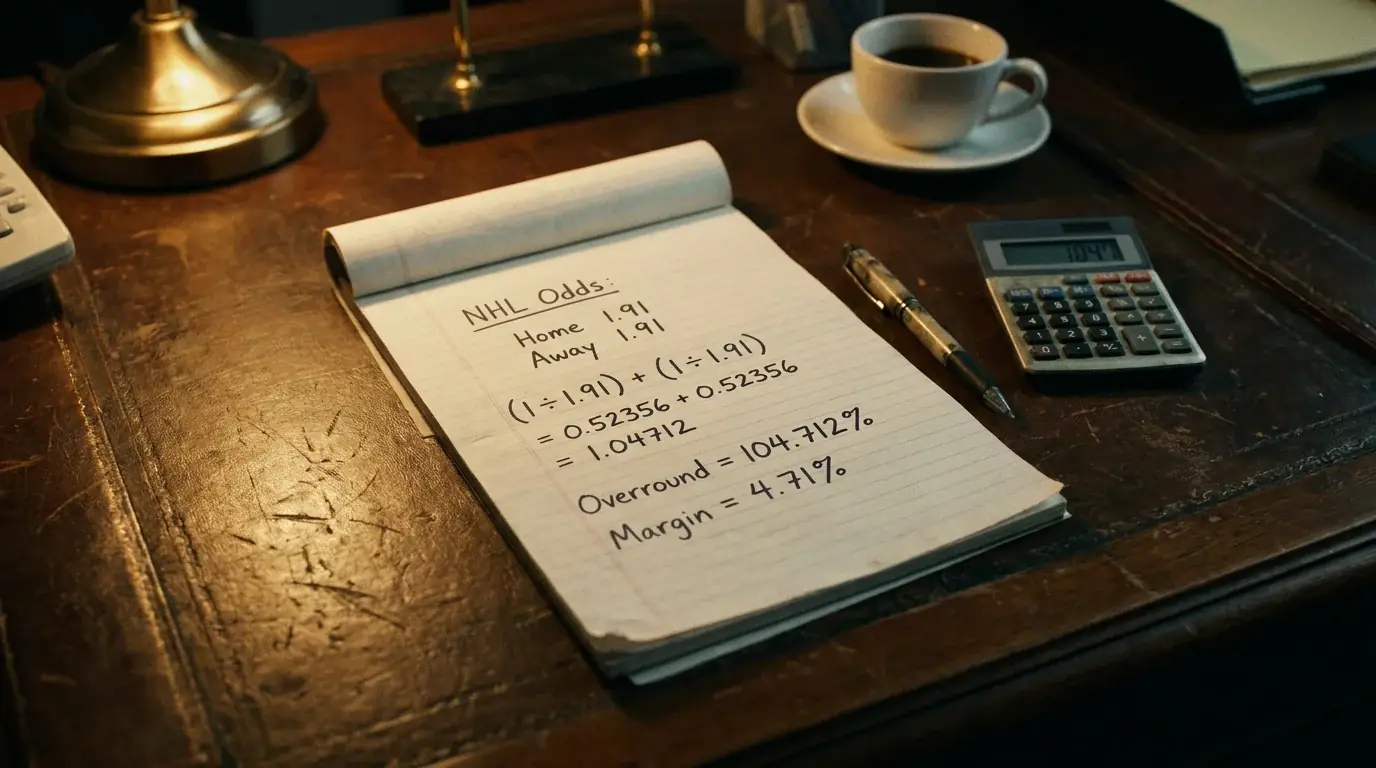
Step three: compare the line across at least three UKGC-licensed bookmakers. The average margin on NHL moneylines in the UK runs between 4% and 6%, and that margin is not uniform. One operator might price a favourite at 1.65 while another offers 1.70 — that difference compounds over hundreds of bets into real money. Line shopping is not optional; it is the easiest way to claw back margin without improving your handicapping by a single percentage point.
Step four: confirm the bet type matches the edge. If your analysis points to a tight, low-scoring game, the right bet is the under or a puck line underdog, not a moneyline favourite at short odds. If you see a blowout brewing because of a massive goaltending mismatch, the favourite puck line at -1.5 may offer more value than the moneyline. Match the market to the thesis, not the other way around.
Step five: size the bet according to your bankroll rules. I use flat staking at 1% to 2% of my total bankroll per wager, adjusting only slightly for high-confidence plays. The temptation to oversize a “sure thing” is the fastest route to ruin. An 82-game season plus playoffs gives you more than enough volume to let a small, consistent edge compound. Trust the process and let the maths do the heavy lifting.
NHL Betting Strategy FAQ
Are there strategies for betting on NHL back-to-back games?
Yes. Teams playing the away leg of a back-to-back have won only about 40% of their games since 2023, making the opposing side a consistent value angle. The edge is strongest when the travelling team crosses multiple time zones and starts a backup goaltender. Check the schedule each week, confirm the goalie, and compare the line across several bookmakers before committing.
How important is goalie confirmation before placing an NHL bet?
It is the single most important pregame check. A switch from a starting goaltender to a backup can shift the moneyline by 10 to 20 cents and push totals higher. Placing a bet before the goalie is confirmed means you are wagering on stale information. Wait for the morning skate announcement — typically between 16:00 and 17:30 GMT — before finalising any NHL wager.
What is the best NHL betting system for beginners?
Start with the pre-bet checklist: confirm the goalie, scan the schedule for fatigue spots, compare lines across at least three bookmakers, match your bet type to your analysis and size each wager at 1-2% of your bankroll. This routine requires no advanced modelling — just discipline and publicly available data. As you gain experience, layer in underdog and totals strategies backed by the statistics outlined in this guide.
Written by the editors at NHL Hockey Bets.