
NHL Bet Types: Every Market Explained with Worked Examples
 Available in US

Table of Contents
- Navigating the NHL Betting Menu
- Moneyline: Picking the Winner
- Puck Line: the NHL Spread
- Totals (Over/Under): Forecasting Goal Volume
- Parlays and Accumulators: Combining NHL Selections
- Prop Bets and Player Props: Beyond the Scoreline
- Futures: Season-Long and Stanley Cup Markets
- Which Bet Type Fits Your Style
- NHL Bet Types FAQ
Navigating the NHL Betting Menu
The first time I opened an NHL betting card on a UK sportsbook, the menu looked like a foreign language. Moneyline, puck line, totals, period betting, player props, same-game parlays — and that was just for a single game. Coming from a football background where the match result, both teams to score and a handful of accumulators covered most punters’ needs, the sheer volume of NHL markets felt overwhelming.
It does not need to be. Every NHL bet type is a different lens on the same question: what do you think will happen in this game, and how precisely can you express that view? The moneyline asks the simplest version — who wins. The puck line adds margin — who wins and by how much. Totals remove the winner entirely and focus on goal volume. Props zoom in on individual players. Parlays bundle multiple views into a single ticket with compounded odds. Once you understand each lens, picking the right one for a given game becomes intuitive.
NHL underdogs won 39.1% of their games outright in the 2024/25 season — a rate that makes hockey one of the most unpredictable major team sports on the planet. That unpredictability is precisely why different bet types matter: a moneyline favourite at short odds might not justify the risk, but the same game viewed through the puck line or a player prop could offer genuine value. The market you choose shapes your edge as much as the pick itself. Every example in this guide uses pounds sterling and decimal odds, with concrete payouts calculated on £10 and £20 stakes.
Moneyline: Picking the Winner
I always tell new bettors to start here. The moneyline is the cleanest, most transparent market in hockey: pick the team that wins the game, including overtime and shootouts if necessary. No spreads, no goal totals, no complications. Your team wins, you win. Your team loses, you lose. That simplicity makes it the ideal entry point for anyone new to NHL wagering.
A worked example makes the mechanics concrete. Suppose Team A is priced at 1.65 and Team B at 2.30 on the moneyline. A £10 bet on Team A at 1.65 returns £16.50 total — your £10 stake plus £6.50 in profit. A £10 bet on Team B at 2.30 returns £23.00 — your stake plus £13.00 profit. Team A is the favourite, priced shorter because the market gives them a higher probability of winning. Team B is the underdog, offering a bigger payout because the market thinks they are less likely to prevail.

The numbers behind moneyline betting reveal something important about where value tends to live. Home favourites in the NHL win roughly 64.1% of their games straight up — a solid rate, but not as dominant as the prices sometimes suggest. Meanwhile, underdogs won 39.1% outright across the 2024/25 season, meaning the underdog wins more often in hockey than in football, basketball or most other major sports. That frequency makes the moneyline underdog a legitimate long-term play in a way it simply is not in the Premier League, where draws absorb a chunk of the probability the underdog would otherwise hold.
The main risk of moneyline betting on favourites is the short price. A favourite at 1.45 needs to win about 69% of the time to break even after margin. If that team’s true win probability is only 62%, you are overpaying for every ticket. Conversely, an underdog at 2.60 only needs to win about 38% of the time to be profitable — and in the NHL, 39.1% of underdogs do exactly that. The moneyline is simple, but its simplicity hides a constant tension between price and probability. The bettors who thrive here are the ones who respect that tension rather than blindly backing the shorter price.
Puck Line: the NHL Spread
If the moneyline asks who wins, the puck line asks who wins by enough. It is the NHL’s version of a points spread, almost always set at 1.5 goals. The favourite is listed at -1.5, meaning they must win by two or more goals for the bet to pay. The underdog is listed at +1.5, meaning they can lose by one goal and your bet still wins. It is a market that rewards precision over mere prediction.
Here is how the payout works. Suppose a favourite is priced at 2.45 on the -1.5 puck line. A £10 bet returns £24.50 if that team wins by two or more goals. Compare that to the same team’s moneyline at 1.65, which returns only £16.50 on the same stake. The puck line pays significantly more because the condition is harder to meet — the team must not just win but win comfortably. On the flip side, the +1.5 underdog might be priced at 1.55. A £10 bet returns £15.50, and it wins as long as the underdog does not lose by two or more goals. In a league where 30% of games reach overtime, that cushion is substantial.

The data behind puck line betting is striking. Home underdogs cover the +1.5 puck line 63.9% of the time — nearly two out of three games. Home favourites, meanwhile, cover the -1.5 puck line only 41.8% of the time. That split alone should reshape how you think about the puck line. Backing the home underdog on the spread is not a gamble; it is siding with a structural edge that the market has consistently underpriced. For a deeper dive into the mechanics of +1.5 and -1.5, including how overtime and shootouts interact with puck line settlement, the puck line explainer covers every scenario.
When is the puck line better than the moneyline? Two situations stand out. First, when you are confident a favourite will dominate — say a top-five team hosting a bottom-five team with the backup goaltender in net — the -1.5 puck line at 2.30 or higher can offer far more value than a moneyline at 1.40. Second, when you like an underdog but do not quite trust them to win outright, the +1.5 puck line gives you a cushion: they can lose 3-2 and you still collect. The puck line is a bet on margin, and in the NHL, margins are often thinner than the moneyline suggests.
Totals (Over/Under): Forecasting Goal Volume
Totals strip away the question of who wins and focus purely on how many goals the game produces. The bookmaker sets a line — almost always 6.5 in the NHL — and you bet whether the combined score will be over or under that number. It sounds simple, and structurally it is. But the analytical work behind a good totals bet is some of the sharpest in the sport.
A worked example: the total is set at 6.5, with over priced at 1.90 and under at 1.90. A £20 bet on the over returns £38.00 if the game produces seven or more combined goals. A £20 bet on the under returns £38.00 if the game finishes with six or fewer. If the final score is 4-3 — seven combined goals — the over wins. If it is 3-2 — five combined — the under wins. No partial payouts, no draws. The only grey area is if the combined total lands exactly on a whole-number line like 6.0, where some operators push the bet (return your stake). At the standard 6.5, there is always a winner.

Why 6.5? Because NHL games cluster tightly around five to seven combined goals. The distribution is narrow compared to higher-scoring sports, and 6.5 sits in the heart of that cluster. The edge for bettors comes from understanding which factors push a particular game towards the fringes. Unders have historically hit at a 51.2% rate — a slight but persistent lean that rewards disciplined under betting over large samples. Goaltending quality, back-to-back fatigue, defensive system strength and arena altitude all feed into whether a specific game is likely to land above or below the line.
The danger with totals is overthinking. I have seen bettors build elaborate models to project goal volume and still end up no better than a coin flip. My approach is simpler: identify the two or three factors that most strongly influence scoring in a given matchup — typically goaltending and fatigue — and let those drive the decision. If the starting goaltenders are elite and both teams are rested, lean under. If both sides are on the second night of a back-to-back with backups in net, the over has a structural tailwind. The complexity is in the preparation, not the bet itself.
Parlays and Accumulators: Combining NHL Selections
In UK betting language, a parlay is an accumulator — multiple selections combined into a single bet where every leg must win for the ticket to pay out. The appeal is obvious: the odds multiply, and a modest stake can produce a substantial return. A three-leg accumulator at 2.00 on each selection compounds to 8.00 — a £10 bet returns £80. That multiplied payout is what draws punters in. The maths of compounded risk is what should give them pause.
Each leg you add to an accumulator multiplies not just the odds but also the bookmaker’s margin. If each individual market carries a 5% margin, a three-leg acca effectively embeds roughly 15% in cumulative margin. A five-leg acca can carry 25% or more. You are paying the operator for every selection, and the longer the accumulator, the steeper that hidden cost becomes. That does not mean accumulators are always a bad bet — but it does mean they are structurally harder to beat than single bets, and you should treat them as occasional weapons rather than a daily staple.
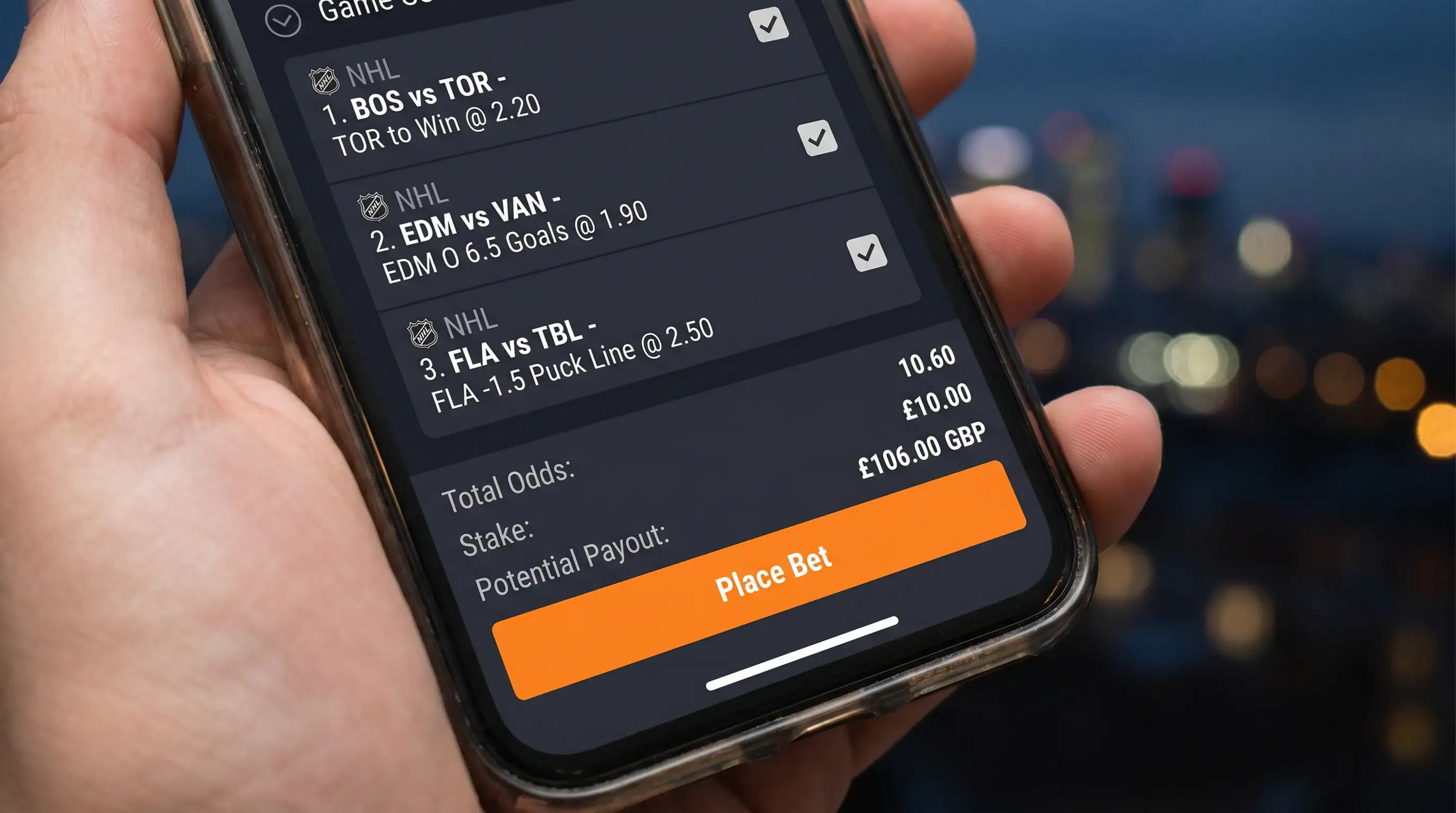
When do accumulators make sense in NHL? I use them in two situations. First, when I have two or three strong, uncorrelated pregame picks that I want to combine for entertainment value — a favourite moneyline in one game and an under in another, for example. The key word is “uncorrelated”: combining a moneyline and a total from the same game creates hidden dependencies (teams that are winning tend to protect leads, which pushes games under). Second, I use small-stake accumulators on playoff nights when the card is short and every game feels high conviction. The ticket size stays small, the expected value is negative, and I treat it purely as a way to increase engagement across multiple games.
What I never do: build five-leg-plus accumulators at minimum stakes, hoping for a windfall. The hit rate on long accas is brutal, and the margin erosion ensures that even a sharp bettor runs at a loss over enough volume. If you want compounded odds, keep it to two or three legs, stick to uncorrelated markets and accept that the accumulator is a tactical addition to your card — not the foundation of it.
Prop Bets and Player Props: Beyond the Scoreline
Prop bets — short for proposition bets — detach your wager from the final result and attach it to a specific event within the game. Did a particular player score a goal? Did the game produce a goal in the first five minutes? Was the first penalty a hooking call? Props turn every granular detail of a hockey game into a tradeable market, and for bettors who are willing to do the legwork, they offer some of the juiciest mispricings in the sport.
Player props are the most popular category. You can bet on a skater’s goals, assists, points, shots on goal or even blocked shots. Goaltender-specific props cover saves, shutouts and win/loss outcomes. The beauty of these markets is that they are priced off individual performance models, which are inherently noisier than team-level models. A top-six forward who has been cold for three games might see his goal-scorer prop priced generously, even though his underlying shot quality and ice time have not changed. That kind of disconnect between short-term results and sustainable performance metrics is where value lives.

Game props offer a different angle. First-period total goals, first team to score, whether the game goes to overtime, the method of the first goal — these are markets that hinge on situational factors rather than individual talent. Overtime props are particularly interesting given the rate at which NHL games reach extra time this season. If you identify a matchup between two evenly matched teams with strong goaltending, the “yes” on overtime can carry positive expected value at the right price.
A word of caution: prop markets carry wider bookmaker margins than moneylines or totals. The tradeoff for greater variety is a steeper cost per bet. I treat props as a targeted tool — one or two per card, backed by specific research — rather than a scattergun approach. If you are betting eight player props a night, you are paying eight sets of margin and your edge had better be wide enough to absorb that cost.
Futures: Season-Long and Stanley Cup Markets
Futures are the marathon bets of NHL wagering. Instead of picking a game outcome tonight, you are picking an outcome that might not settle for months — the Stanley Cup winner, the division champion, a player to win the Hart Trophy. The odds are long, the timeline is slow and the emotional payoff, when it hits, is enormous.
The NHL is a league generating over $7 billion in annual revenue, with franchise values climbing steeply and media deals pouring cash into the ecosystem. That financial growth matters for futures bettors because it drives parity. Revenue sharing, the salary cap and aggressive competitive-balance mechanisms mean that pre-season predictions are upended regularly. Dark-horse teams emerge every year, and the bookmaker’s pre-season favourite wins the Cup far less often than casual fans expect. That structural unpredictability is what makes futures markets tradeable rather than merely decorative.

The key decision with any future is timing. Prices are longest before the season starts, when uncertainty is highest. As the season progresses and the standings crystallise, contenders’ odds shorten and longshots lengthen. Betting a future early locks in a higher price but ties up capital for months and carries the risk of injuries, trades and form reversals. Betting later gives you more information but at a worse price. I split the difference: I place a small futures bet before the season on one or two teams I rate highly, then look for in-season opportunities when a legitimate contender suffers a temporary slump that pushes their price out further than it should go.
One more nuance: futures margins are among the widest in the entire sportsbook. A Stanley Cup winner market with 32 teams might carry an overround of 30% to 50% or higher. You are paying a steep premium for the privilege of holding a long-term position. Accept that cost going in, size your stake accordingly and view futures as a small allocation within a broader NHL betting portfolio rather than the centrepiece.
Which Bet Type Fits Your Style
After ten years of analysing NHL markets, I have arrived at a conviction that sounds obvious but takes most people a long time to accept: the bet type matters as much as the pick. A strong read on a game is wasted if you express it through the wrong market, and a mediocre read channelled through the right market can still produce positive returns.
If you are patient and process-driven, moneylines and totals are your bread and butter. They carry the lowest margins, offer the largest sample sizes for tracking results and reward disciplined, repeatable analysis. Goalies swing outcomes, totals cluster tightly, and the long season produces fatigue spots you can exploit — those edges align perfectly with single-game, single-market bets where the margin cost is minimal.

If you enjoy deeper analysis and do not mind wider margins, player props and same-game parlays let you express a thesis that no single market can capture. You might believe a particular forward will score against a weak penalty kill unit while the game stays low-scoring overall — that view requires a prop plus a total, combined in a parlay or a same-game parlay. The margin is higher, but the specificity of the bet means you are competing in a market where fewer sharp bettors operate, and the pricing can be softer.
If you have a long time horizon and enjoy researching roster construction, salary cap dynamics and coaching changes, futures give you a canvas that single-game bets cannot. The key is accepting the wide margins and the capital lockup, and sizing your futures bets as a small percentage of your total bankroll.
And if you thrive on adrenaline and fast decision-making, live betting during games — covered in depth in the in-play strategy guide — offers an entirely different rhythm. The bet types available in-play are a subset of the pregame menu, but the context changes everything. A moneyline bet placed at intermission after watching thirty minutes of action is a fundamentally different proposition from the same moneyline bet placed six hours before puck drop.
The takeaway: do not default to one bet type out of habit. Match the market to your analysis, your risk tolerance and your style. The NHL menu is deep enough to accommodate every kind of bettor. Use it.
NHL Bet Types FAQ
What is the difference between a puck line and a moneyline?
The moneyline asks you to pick the winner of the game, regardless of the margin. The puck line adds a 1.5-goal spread: the favourite must win by two or more goals at -1.5, while the underdog can lose by one and still cover at +1.5. Moneyline prices are shorter because the condition is easier to meet. Puck line prices are longer because the margin requirement makes the bet harder to win.
Do NHL accumulators include overtime results?
Yes. Standard NHL moneyline and total bets — and therefore accumulators built from them — include overtime and shootout results. A moneyline leg settles on the final result after overtime or shootout. Totals include overtime goals but typically exclude the shootout, which counts as a single goal for the winning team regardless of how many rounds were played. Always check the specific settlement rules on your bookmaker’s platform, as minor variations exist.
Which NHL bet type has the lowest bookmaker margin?
Moneyline markets on high-profile NHL games generally carry the tightest margins, typically in the 4% to 5% range on competitive UK platforms. Totals run slightly wider, often 5% to 6%. Puck lines, player props and same-game parlays carry progressively wider margins. The rule of thumb: the simpler and more liquid the market, the lower the margin.
Can I combine prop bets in an NHL same-game parlay?
On most UK bookmakers that offer same-game parlays for NHL, you can combine player props with game-level selections like the moneyline or total. For example, you might pair a player to score a goal with the game going under 6.5 goals. Not all combinations are available — correlated selections may be restricted — and the compounded margin on multi-leg same-game parlays is significantly higher than on individual bets.
Written by the editors at NHL Hockey Bets.