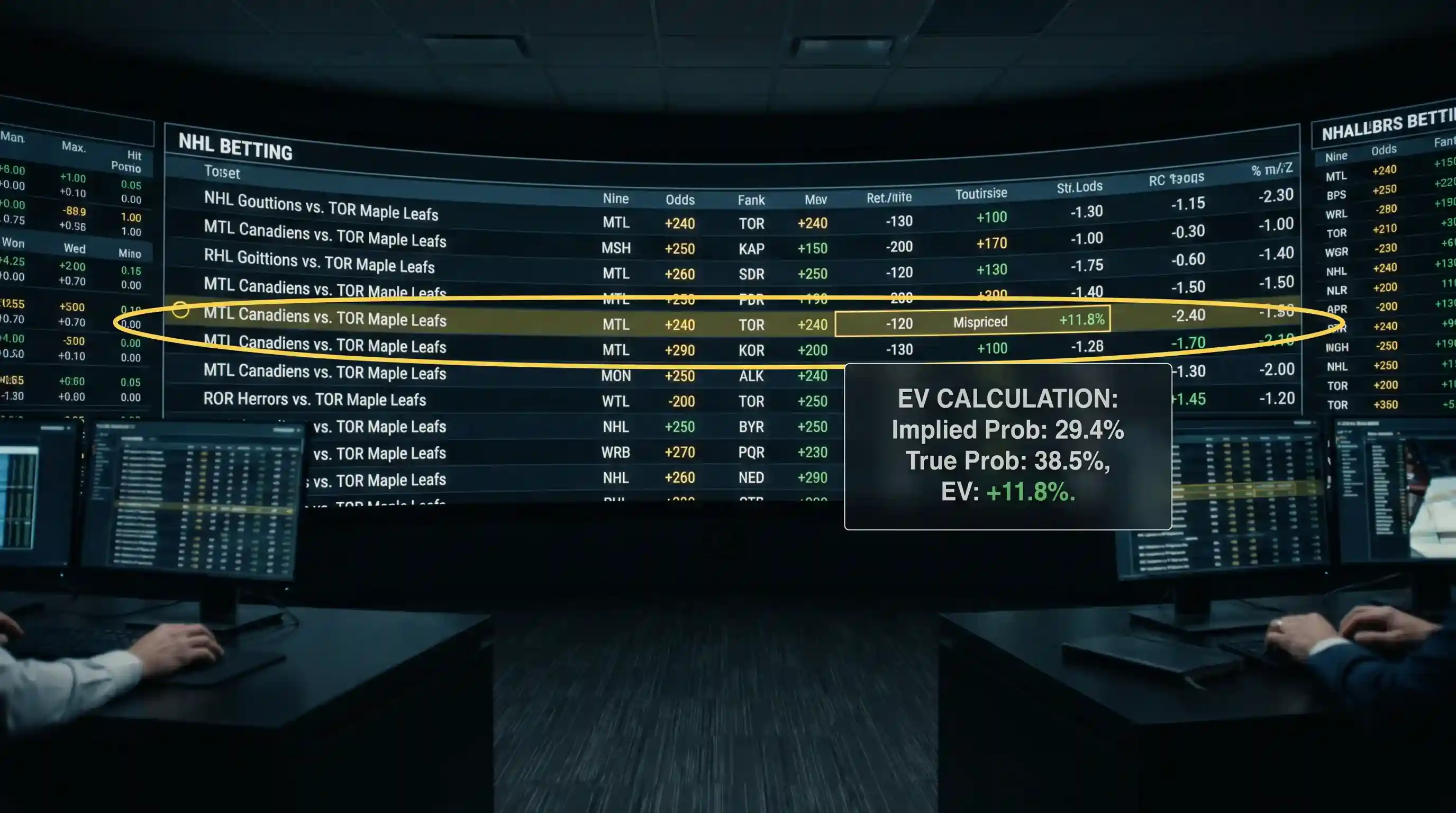
NHL Betting Margins: Understanding the Vig and Why It Matters
 Available in US
The Hidden Cost in Every NHL Bet
Nobody walks into a shop and pays a price without knowing what it costs. Yet every day, thousands of bettors place NHL wagers without understanding the built-in fee they are paying on each one. That fee — called the margin, vig, vigorish, juice, or overround depending on who you ask — is the bookmaker’s profit mechanism, and on NHL moneylines in the UK it typically sits between 4% and 6%. It is not printed on your bet slip. It is not deducted from your account separately. It is embedded invisibly in the odds, which makes it the most important number most bettors never think about.
Over a single bet, the margin is negligible. Over a hundred bets, it determines whether your results tilt toward profit or loss. Two bettors with identical strike rates can produce opposite outcomes solely because one pays a 4% margin and the other pays 6%. That two-percentage-point gap, compounded across a full NHL season, is the difference between grinding out a modest profit and slowly bleeding your bankroll dry.
How to Calculate a Bookmaker’s Margin from Odds
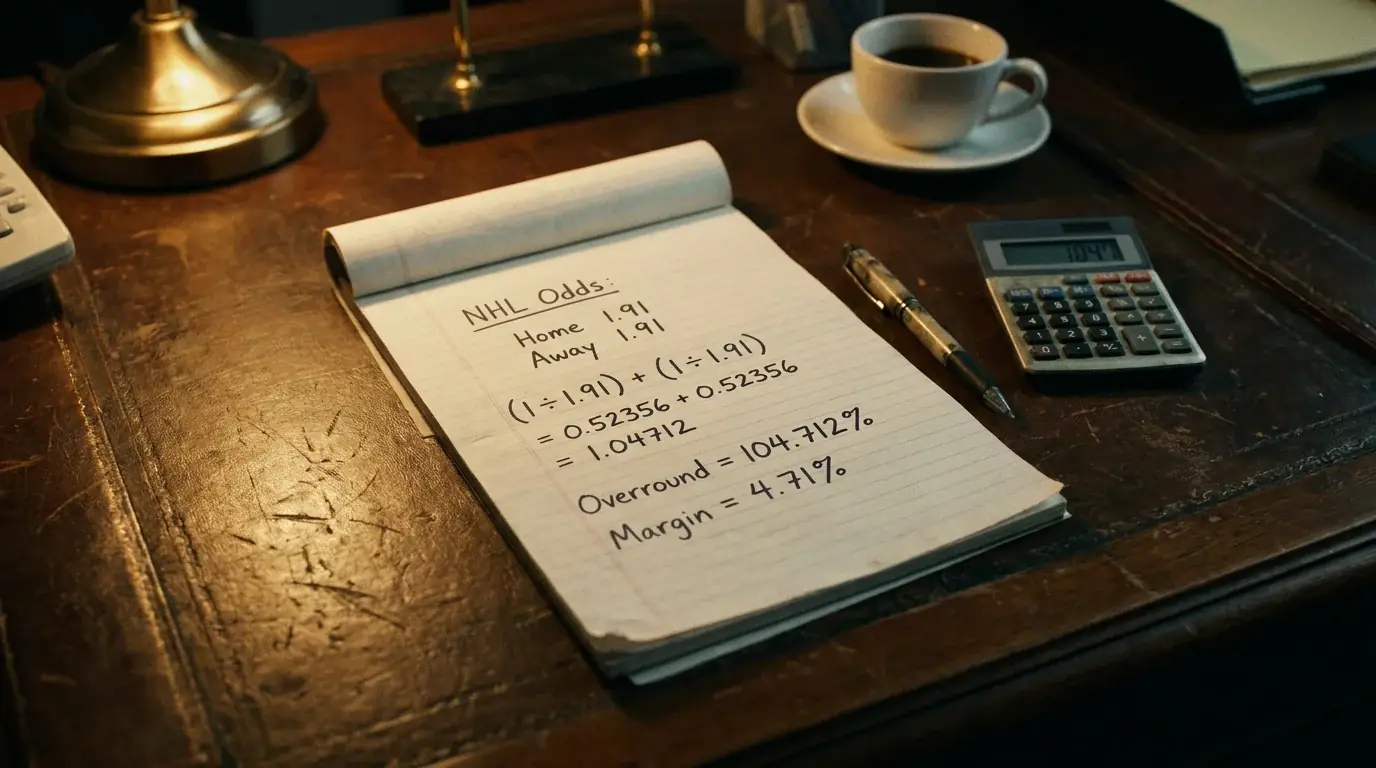
The calculation is simple enough to do on a phone calculator. Take the decimal odds on each side of a two-way market — say, 1.85 on the favourite and 2.05 on the underdog. Convert each to an implied probability by dividing 1 by the odds: 1/1.85 = 54.05%, and 1/2.05 = 48.78%. Add the two implied probabilities: 54.05% + 48.78% = 102.83%. Subtract 100%, and you have the margin: 2.83%.

A “fair” market — one with zero margin — would add up to exactly 100%. Everything above that is the bookmaker’s edge. An NHL moneyline with a total implied probability of 104% carries a 4% margin; one that totals 106% carries 6%. The higher the number, the more you are overpaying relative to the true probabilities of each outcome.
Here is the practical impact. Imagine two bookmakers pricing the same game. Bookmaker A offers 1.87 and 2.00 (margin 3.54%). Bookmaker B offers 1.80 and 1.95 (margin 6.83%). You back the favourite at each. At Bookmaker A, a 10 GBP stake returns 18.70 GBP. At Bookmaker B, the same stake returns 18.00 GBP. That 0.70 GBP difference per bet is the real cost of the margin gap. Over 200 bets in a season, it adds up to 140 GBP — money that leaves your pocket purely because you chose the wrong bookmaker, not the wrong team.
Typical NHL Margins in the UK: 4-6% and What Drives Them
The 4-6% range for NHL moneylines in the UK is a general benchmark, but within that band there is meaningful variation between operators, between markets, and between matchups. Main moneylines on high-profile games — Original Six matchups, playoff contenders, primetime ESPN broadcasts — tend to carry tighter margins because they attract more volume, and bookmakers can afford to offer sharper prices when they know the liability will balance naturally.

Lower-profile games, particularly midweek matchups between non-contending teams, often carry wider margins. The bookmaker receives less volume on these games and prices conservatively to protect against sharp money. Prop markets and alternative lines — period betting, exact totals, player props — push even wider, sometimes reaching 8-10%. The more obscure the market, the higher the margin, because fewer bettors are comparing prices and fewer sharp players are forcing the line to move toward efficiency.

More than 80 online bookmakers hold UKGC licences, and the margin each applies to NHL markets varies. Some operators position themselves as low-margin sportsbooks, accepting thinner profit per bet in exchange for higher volume. Others run wider margins but offer compensating features — live streaming, enhanced odds promotions, or a broader range of NHL props. Understanding which type of operator you are using helps set expectations about the margin you are paying.
Comparing margins across operators is the simplest way to reduce the vig’s impact. If you hold accounts with three or four UKGC-licensed bookmakers, you can check the implied probability total for each game and consistently place your bet at the tightest market. Over a season, this habit alone can save you hundreds of pounds in hidden margin costs.
Practical Steps to Reduce the Margin You Pay
The first step is awareness. Before clicking “place bet”, run the margin calculation on any market you are about to enter. It takes ten seconds and immediately tells you whether you are getting a competitive price or a padded one. If the combined implied probability exceeds 106%, you are paying too much — close the app and check elsewhere.

The second step is multiple accounts. Three to five bookmaker accounts, all UKGC-licensed, gives you enough range to compare prices on every game. Odds comparison sites aggregate these prices in real time, but even a manual check across three apps takes less than a minute per game. The effort-to-reward ratio is absurdly favourable.

The third step is timing. NHL odds tend to tighten as game time approaches, because sharp money forces the lines toward efficiency. Betting early in the day often means accepting a wider margin; betting an hour before puck drop usually captures a tighter market. The exception is goalie-confirmation plays, where betting immediately after a goalie announcement catches a line in transition — the margin may still be wide, but the direction of the move creates temporary value that outweighs the vig.
The fourth step is selectivity. You do not have to bet every game. The margin is a fixed tax on each wager, and adding volume without adding edge simply multiplies the tax. If you bet 50 games per month at a 5% margin, the theoretical cost is 2.5 units. If you bet 20 games with the same margin, the cost drops to 1.0 unit, and your strike rate per bet typically improves because you are only backing your strongest selections. Fewer, sharper bets at the best available price is the simplest path to outpacing the margin over a full season.
What causes some NHL markets to carry higher margins than others?
Volume and competition drive the difference. High-profile games attract more bets, allowing bookmakers to offer tighter margins because liability balances naturally. Lower-profile matchups and niche markets like player props receive less volume, so bookmakers widen margins to protect against sharp bettors. The more obscure the market, the higher the margin tends to be.
Is a 4% margin good for NHL bets?
For UK NHL markets, 4% is on the competitive end of the spectrum. The average sits between 4% and 6%, so anything below 4.5% represents a relatively sharp price. Some operators on high-volume games push below 3.5%. By comparison, Premier League match result markets typically carry margins of 2-4%, so NHL margins are slightly higher but still workable for disciplined bettors who compare prices across multiple bookmakers.
Published by the NHL Hockey Bets team.