NHL Overtime Betting Rules: What Counts and What Doesn’t
 Available in US

The Overtime Confusion That Costs Bettors Money
A colleague of mine — a sharp bettor who had been profitable on football for years — placed his first NHL totals bet on an over 6.5 line. The game was tied 3-3 after regulation and went to overtime, where the home team scored to win 4-3. Seven total goals. He assumed his over had landed. It had, because standard NHL totals include overtime. But the following week he placed a “regulation time result” bet, expected a draw payout when the game was tied after sixty minutes, and was bewildered to find his bet had settled as a loss because the market he picked did not include a draw option. Two different markets, two different rule sets, and the difference between them ate his profit.
Overtime confusion is the most common source of unnecessary losses for UK bettors entering NHL markets. In the 2025/26 season, approximately 30% of games have been decided in overtime or a shootout — one of the highest rates in decades. That means nearly a third of all games carry an overtime component, and understanding which bets are affected is not optional. It is essential.
Regulation Time vs Full Time: Which Markets Include OT
The critical distinction is between “full time” (also called “including overtime and shootouts”) and “regulation time” (also called “60 minutes” or “regulation only”). Every bookmaker labels these differently, which is part of the problem.
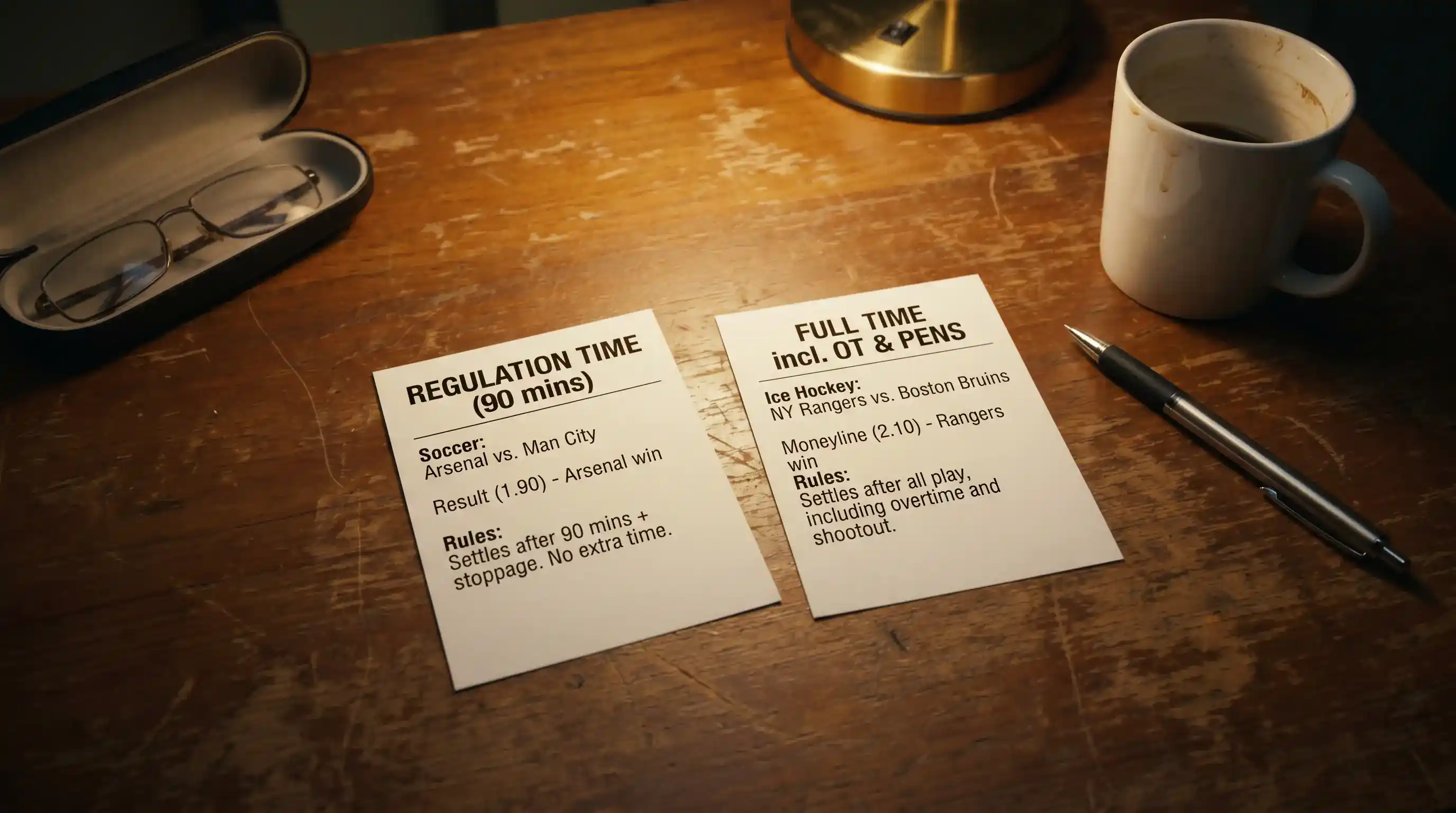
Standard moneyline bets in the UK include overtime and the shootout. If you back a team to win on the moneyline and they win in a shootout, your bet pays. This is the default for the vast majority of UK bookmakers, and it matches how the NHL officially records its results — a shootout winner gets a W in the standings, a shootout loser gets an OTL.
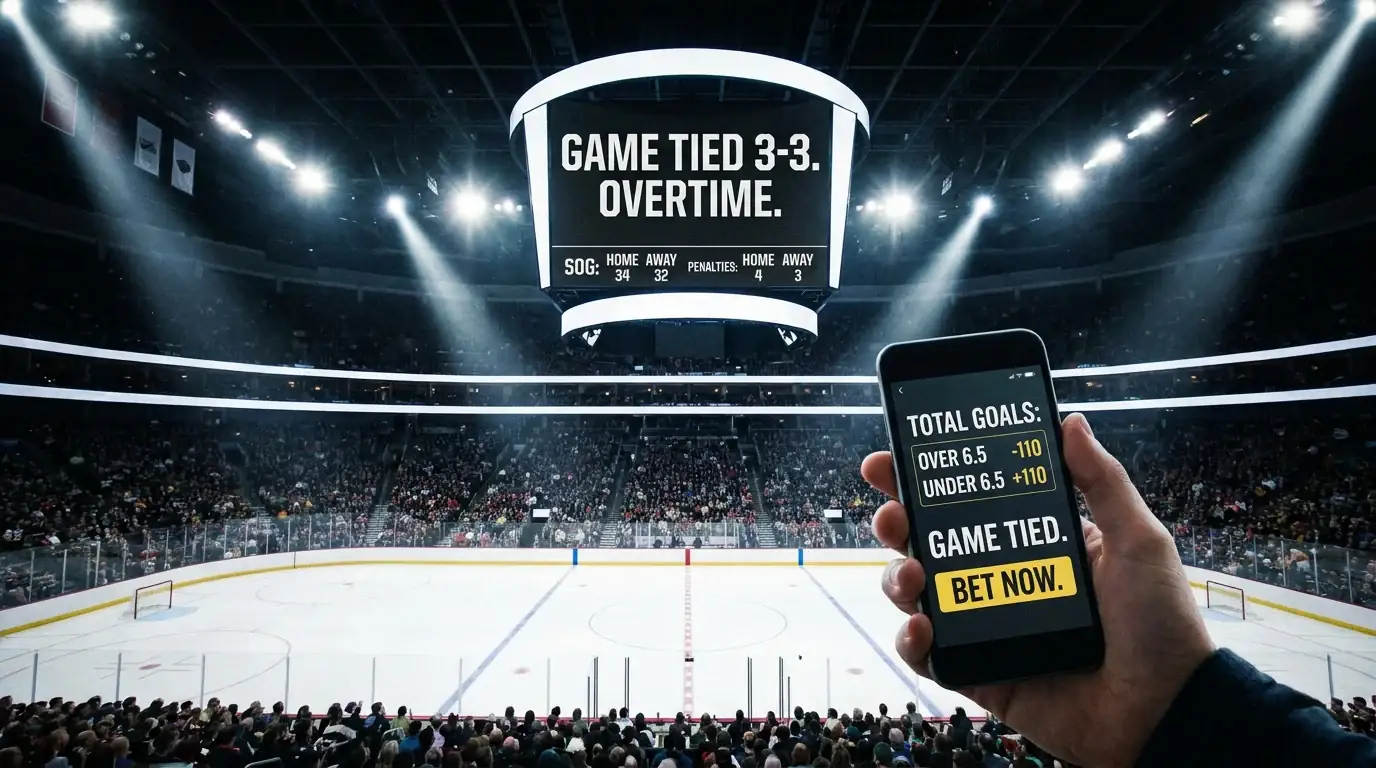
Regulation time result is a separate market that settles after sixty minutes of play. Here, the draw is a possible outcome, because if the game is tied after three periods, it ends as a draw for the purposes of this bet. This market resembles football’s 1X2 structure and appeals to bettors who want the draw option, but the crucial difference is that the draw price tends to be shorter than you might expect — around 3.80 to 4.50 in most matchups — because 30% of games reaching overtime means the draw hits frequently.
Totals (over/under) include overtime and shootout goals on the standard market. A game that finishes 3-3 in regulation and goes to a shootout will be settled as 4-3 or 3-4, adding one goal to the winning team’s total. Some bookmakers offer “regulation time totals” as a separate market, and here the total would settle at 6 (3+3), excluding any overtime or shootout goals. The difference matters enormously when the standard total is 6.5 — a game that finishes 3-3 in regulation and 4-3 in overtime crosses the over on the full-time market but stays under on the regulation-time market.
Puck line bets also include overtime and shootouts. If your team is +1.5 and loses in a shootout, the official score records a one-goal loss (e.g. 3-2), so the +1.5 covers. If your team is -1.5, a shootout or overtime result almost always means the margin is exactly one goal, which does not cover.
Shootout Goals and How They Affect Different Bet Types
Shootouts add exactly one goal to the winning team’s score in the official NHL box score, regardless of how many rounds the shootout lasts. A game tied 2-2 after overtime that is decided in a shootout becomes 3-2 in the final tally. This affects totals directly: the combined score moves from 4 to 5, potentially flipping an under to an over.

Player props are where shootout rules get tricky. A goal scored in the shootout does not count as a goal for individual player statistics. If a player scores the winning shootout goal, it does not add to their season goal total, and for betting purposes, their “anytime goalscorer” prop is not affected. This distinction catches bettors who assume a shootout goal pays out their player goal prop — it does not.
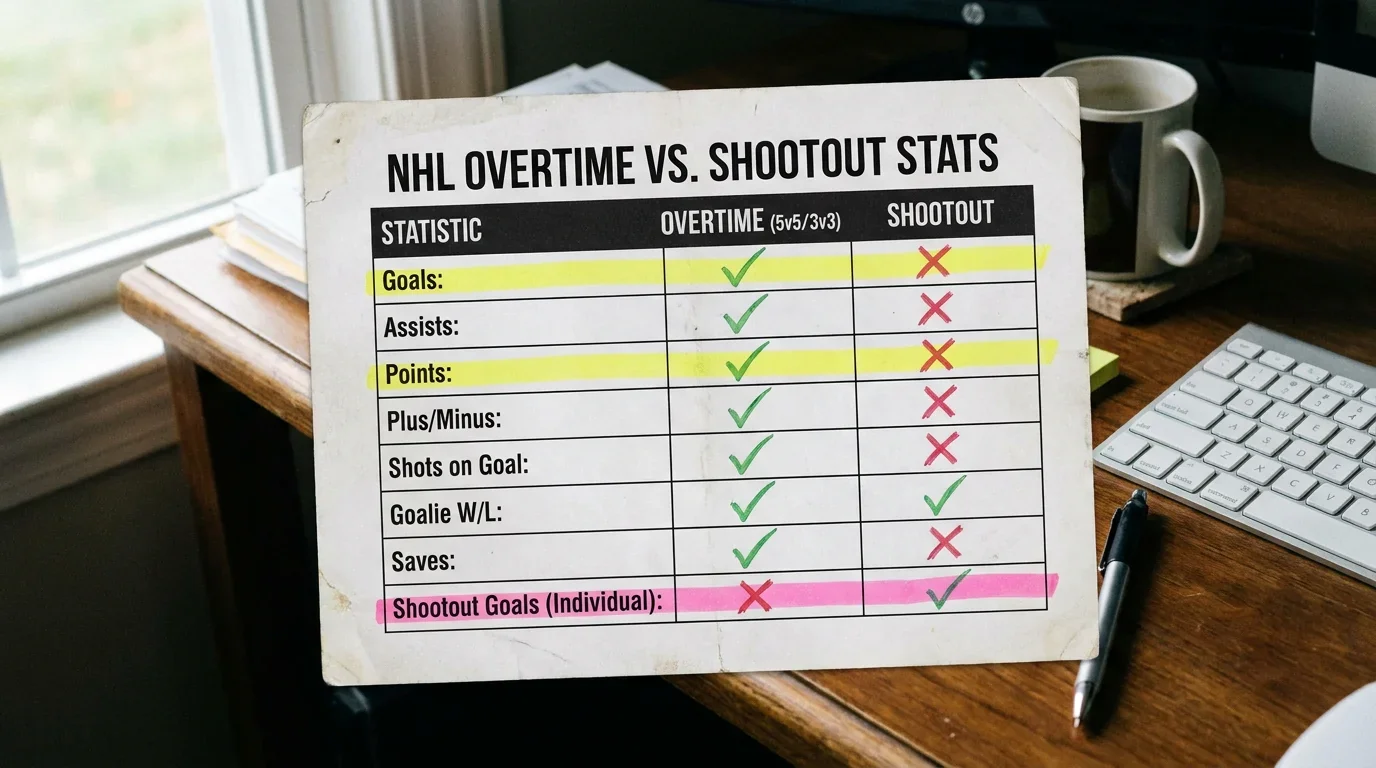
Assists are never recorded in a shootout, so assist props are unaffected. Shots on goal during the shootout are not counted in official shot statistics either, which means player shots props settle based on regulation and overtime shots only. Saves in the shootout are similarly excluded from goaltender save totals for betting purposes. The shootout exists outside the normal statistical framework, and every player prop market treats it accordingly.
The only standard market where shootout outcomes have a direct impact is the moneyline and totals. For everything else — player goals, assists, shots, saves — the shootout is invisible. Keeping this distinction clear prevents the kind of misunderstanding that costs real money over a full season’s worth of totals betting.
Playoff Overtime: Unlimited Periods, Different Rules
Regular-season overtime is a five-minute three-on-three period followed by a shootout if still tied. Playoff overtime is a completely different animal: full twenty-minute periods of five-on-five hockey, repeated until someone scores. There is no shootout in the playoffs. Games can stretch to double, triple, or even quadruple overtime — marathon events that sometimes last longer than two full regulation games combined.

For betting purposes, the most important consequence of unlimited playoff overtime is the impact on totals. A game that grinds through two overtime periods will almost certainly push the total over any standard line. The over on a 5.5 line becomes nearly automatic once a game reaches the second overtime, because even scoreless extra periods accumulate shot volume that eventually produces goals. Bookmakers price playoff totals slightly higher to account for this, but the adjustment is not always sufficient in specific series where both goaltenders are elite and overtime is frequent.
Player props behave differently in playoff overtime too. Unlike shootout goals, overtime goals in the playoffs count fully toward individual statistics. A player scoring the game-winning goal in the second overtime has that goal added to their season total, and any “anytime goalscorer” prop pays out. Assists, shots, and saves from playoff overtime all count as well. This means player props in playoff games have a wider range of outcomes than regular-season games, because the playing time is potentially unlimited.
Understanding the structural difference between regular-season and playoff overtime is essential for anyone betting on the postseason. The shootout rules that govern 30% of regular-season decisions do not apply in the playoffs, and the unlimited-overtime format introduces variance that changes the probability distribution of every standard market.
Do shootout goals count for over/under bets?
Yes, on standard totals markets. A shootout adds one goal to the winning team’s score, so a game tied 3-3 after overtime that is won in a shootout settles as 4-3 for totals purposes (seven total goals). However, if you bet on a ‘regulation time totals’ market, shootout goals are excluded and the total would settle at six.
Does a shootout win count as a moneyline win?
Yes. Standard moneyline bets include overtime and the shootout. If your team wins in a shootout, your bet pays out as a win. The only exception is if you specifically bet on the ‘regulation time result’ market, which settles after sixty minutes and includes the draw as a possible outcome.
How does overtime differ between NHL regular season and playoffs?
Regular-season overtime is a five-minute three-on-three period followed by a shootout if the game remains tied. Playoff overtime consists of full twenty-minute five-on-five periods with no shootout — play continues until a goal is scored, regardless of how many periods it takes. This affects betting because playoff games can produce significantly more total goals through extended overtime, and all overtime statistics count toward player props.
Written by the editors at NHL Hockey Bets.