
NHL Bankroll Management: Staking Plans That Survive a Full Season
 Available in US

Why Bankroll Management Is the Most Underrated NHL Skill
I have met bettors who can break down a team’s expected goals model, identify goaltending mismatches on sight, and read schedule spots like a chess player reads the board — and they still lose money. The reason is almost always the same: they stake randomly. Big bets when they feel confident, small bets when they are cautious, and occasional all-in plays on “locks” that do not exist. They have the analytical edge but bleed it away through chaotic money management.

Bankroll management is the discipline of sizing your bets relative to a fixed bankroll so that inevitable losing streaks do not wipe you out before your edge can compound. It is boring, it is unsexy, and it is the single most important skill separating recreational bettors from profitable ones. Every strategy, every data point, every advanced metric in this sport is worthless if you do not have the bankroll to survive long enough to see it work.
Choosing a Unit Size for NHL Betting
A unit is the standard amount you wager on a single bet, expressed as a percentage of your total bankroll. The most common recommendation is 1-3% per bet, and I lean toward the conservative end. For a 500 GBP bankroll, a 1% unit is 5 GBP. For a 1,000 GBP bankroll, it is 10 GBP.
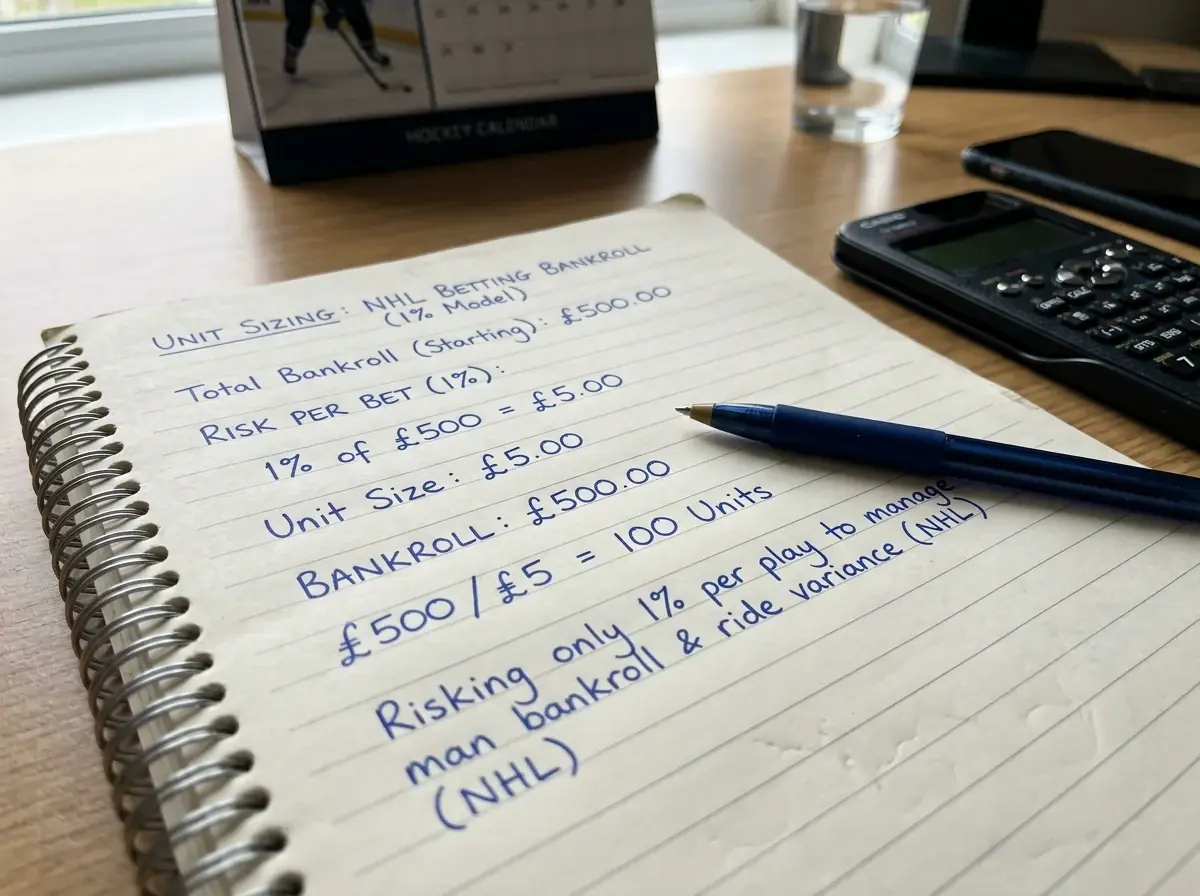
Why so small? Because the NHL is a high-variance sport. Underdogs win 39.1% of games, overtime decides roughly 30% of contests in the current season, and single-goal margins dominate the scoreboard. A five-game losing streak is not a catastrophe — it is a Tuesday. At 1% per unit, a five-game losing streak costs you 5% of your bankroll. At 5% per unit, the same streak costs 25%, and the psychological pressure to chase losses becomes overwhelming.
Set your unit size at the start of the season and recalculate monthly based on your current bankroll. If you start at 500 GBP with 5 GBP units and grow to 600 GBP by November, adjust to 6 GBP units. If you dip to 400 GBP, drop to 4 GBP. This dynamic recalibration keeps your risk percentage constant regardless of whether you are running hot or cold.
Flat Staking vs Variable Staking: Pros and Cons
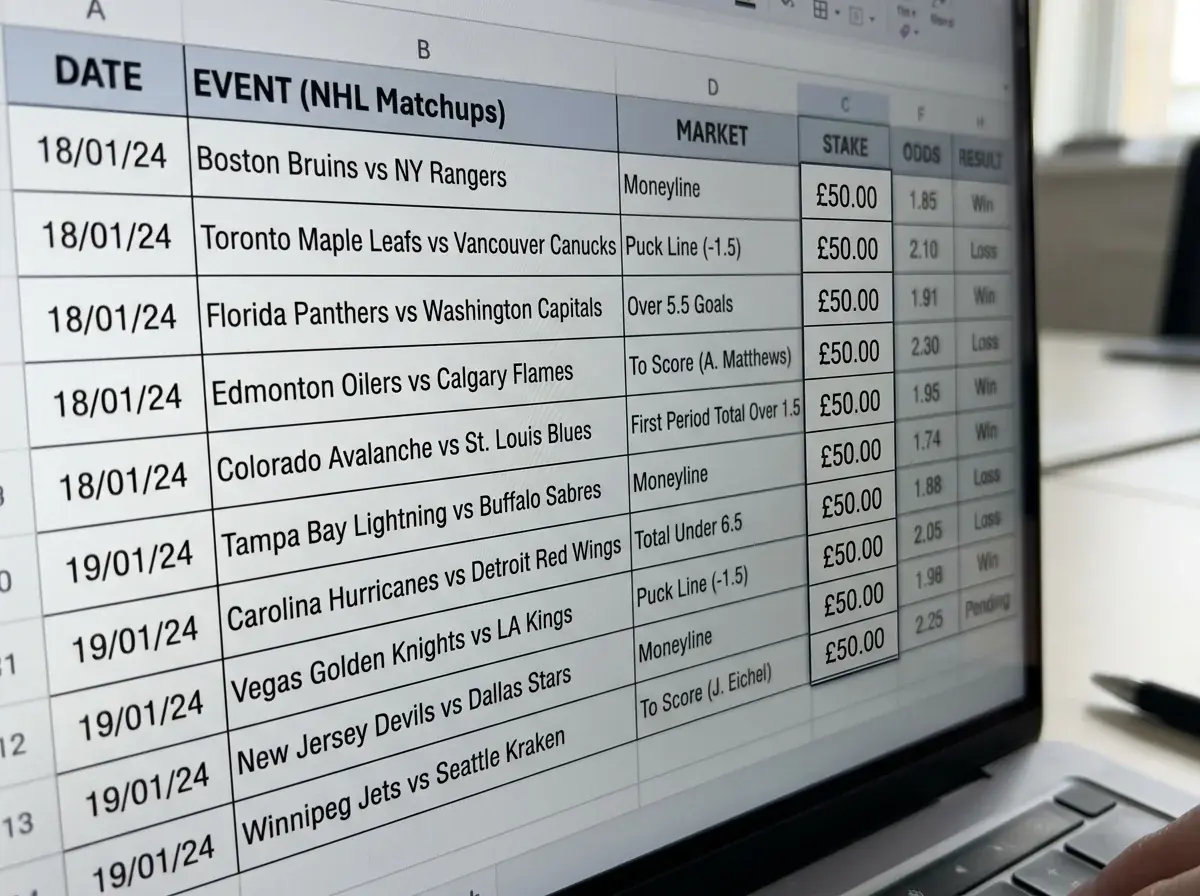
Flat staking means wagering the same unit on every bet regardless of confidence level. If your unit is 10 GBP, every bet is 10 GBP — whether it is a home underdog at 2.80 or a heavy favourite at 1.40. The advantage is simplicity: no decisions to make, no temptation to oversize, no emotional variance layered on top of outcome variance.
Variable staking assigns different unit sizes based on perceived edge or confidence. A standard approach is 1-unit for normal bets, 2-unit for strong plays, and 3-unit for the strongest. NHL underdogs won 39.1% of games in 2024/25, and within that pool, home underdogs covered the puck line at 63.9%. If you have identified a home underdog with a confirmed starting goaltender and the visiting favourite on a back-to-back, that confluence of factors might justify a 2-unit play rather than 1-unit.
The risk with variable staking is self-deception. Every bettor thinks their “strong play” is truly strong, and the temptation to upsize on gut feelings rather than genuine edge is constant. If you go variable, create objective criteria before the season starts: what combination of factors triggers a 2-unit bet versus a 1-unit bet? Write them down, follow them mechanically, and do not adjust mid-season. The moment you start increasing stakes because you “feel it”, you have abandoned the system and returned to gambling.
For most bettors, flat staking is the safer choice. It removes one layer of decision-making and ensures that no single bet can inflict disproportionate damage. I used flat staking for my first five years and switched to a mild variable system (1-unit and 1.5-unit only, no higher) once I had enough data on my own hit rates to define the criteria objectively.
Planning for an 82-Game Season Plus Playoffs
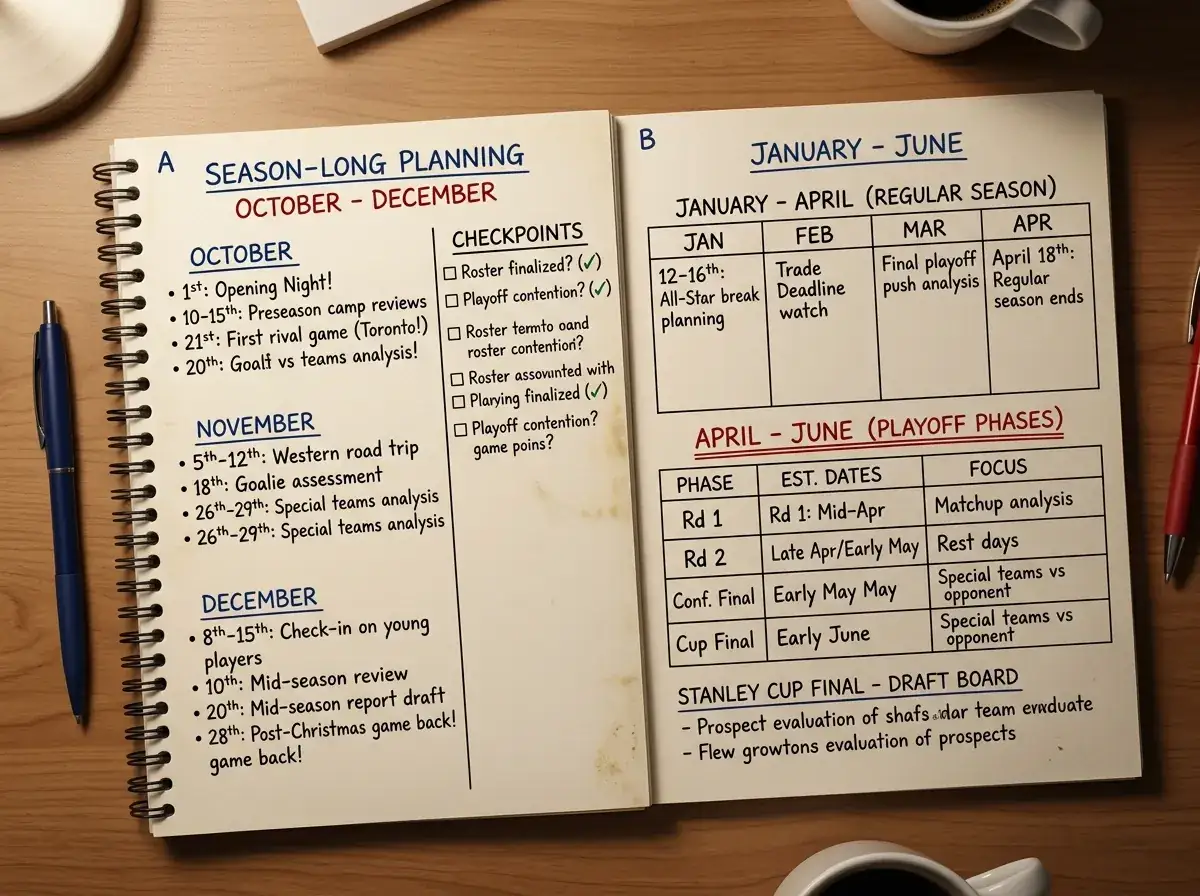
The NHL regular season spans roughly seven months, from October to April, followed by two months of playoffs stretching into June. That is nine months of betting activity, and the volume of opportunity is enormous — more than 1,300 regular-season games plus four rounds of playoff series. No bettor should be active on all of them, but even a selective approach might involve 200-400 wagers across a full season.
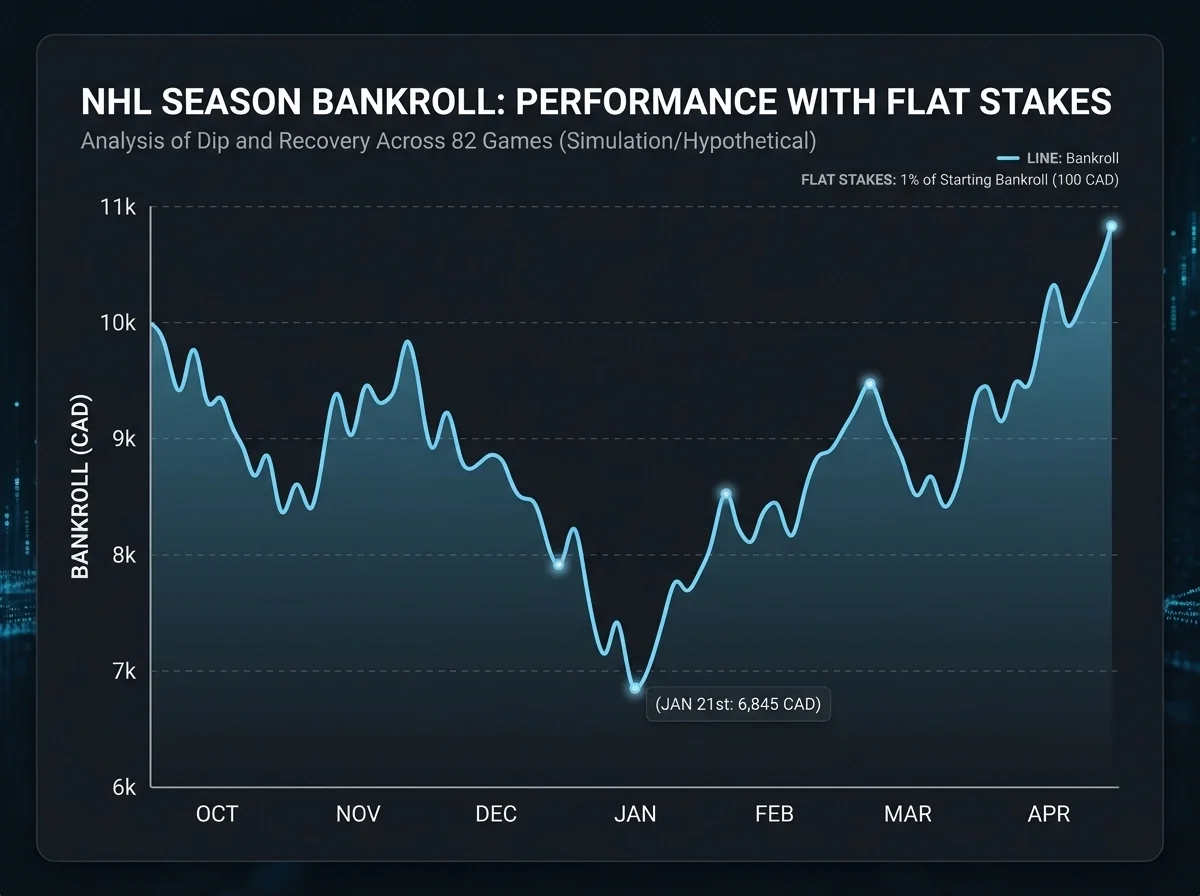
At that volume, variance is a mathematical certainty. Even a sharp bettor with a 55% hit rate on even-money bets will experience stretches of 10 or 15 losses in 20 bets. The bankroll needs to absorb those stretches without forcing you to reduce stakes or, worse, abandon the process entirely. A starting bankroll of 50-100 units provides sufficient cushion for most recreational bettors.
Seasonal rhythm affects bankroll planning too. Early-season games carry more uncertainty because teams are integrating new players and coaches are experimenting with line combinations. Hit rates tend to be lower in October and November, which means your bankroll may dip before it recovers. By January, trends stabilise, and the analytical framework that felt shaky in October starts producing consistent results. The bettors who survive the early-season noise are the ones who sized their bets conservatively enough to remain solvent when the edge kicked in.
Gambling participation in Great Britain is widespread — 47% of respondents in the latest survey reported gambling in the past month — but the proportion who manage their bankroll with any structure is vanishingly small. That structural discipline is the competitive advantage hiding in plain sight. Not a better model, not a secret data source, just the patience to stake consistently and let the numbers accumulate over a full season of value bets rather than chasing each night’s results.
How much should I start with for NHL bankroll?
A practical starting bankroll for recreational NHL betting is 200 to 500 GBP, which at 1-2% unit sizing gives you 2 to 10 GBP per bet. The exact amount depends on your financial situation — it should be money you can afford to lose entirely without affecting your daily life. Starting with a bankroll that supports at least 50 units provides enough cushion to absorb normal variance over a full season.
What unit size is recommended for NHL betting?
Most experienced bettors stake 1-2% of their total bankroll per bet. For a 500 GBP bankroll, that means 5 to 10 GBP per wager. Conservative staking (1%) is recommended for beginners because NHL outcomes are highly variable — underdogs win nearly 40% of games, and losing streaks of five or more consecutive bets are common even for sharp bettors. The unit size should be recalculated monthly based on the current bankroll balance.
Written by the editors at NHL Hockey Bets.