
NHL Underdog Betting Trends: Why 39% Changes Everything
 Available in US

NHL: Where Underdogs Bite Hardest
In football, betting underdogs feels like a leap of faith. In hockey, it is closer to a business model. That distinction is the single most important thing a UK bettor can learn when crossing over from Premier League markets to the NHL. I resisted the idea for years — backing favourites felt safer, more logical, more professional. Then I ran the numbers and realised my favourite-heavy approach had been bleeding money against the margin for three straight seasons.
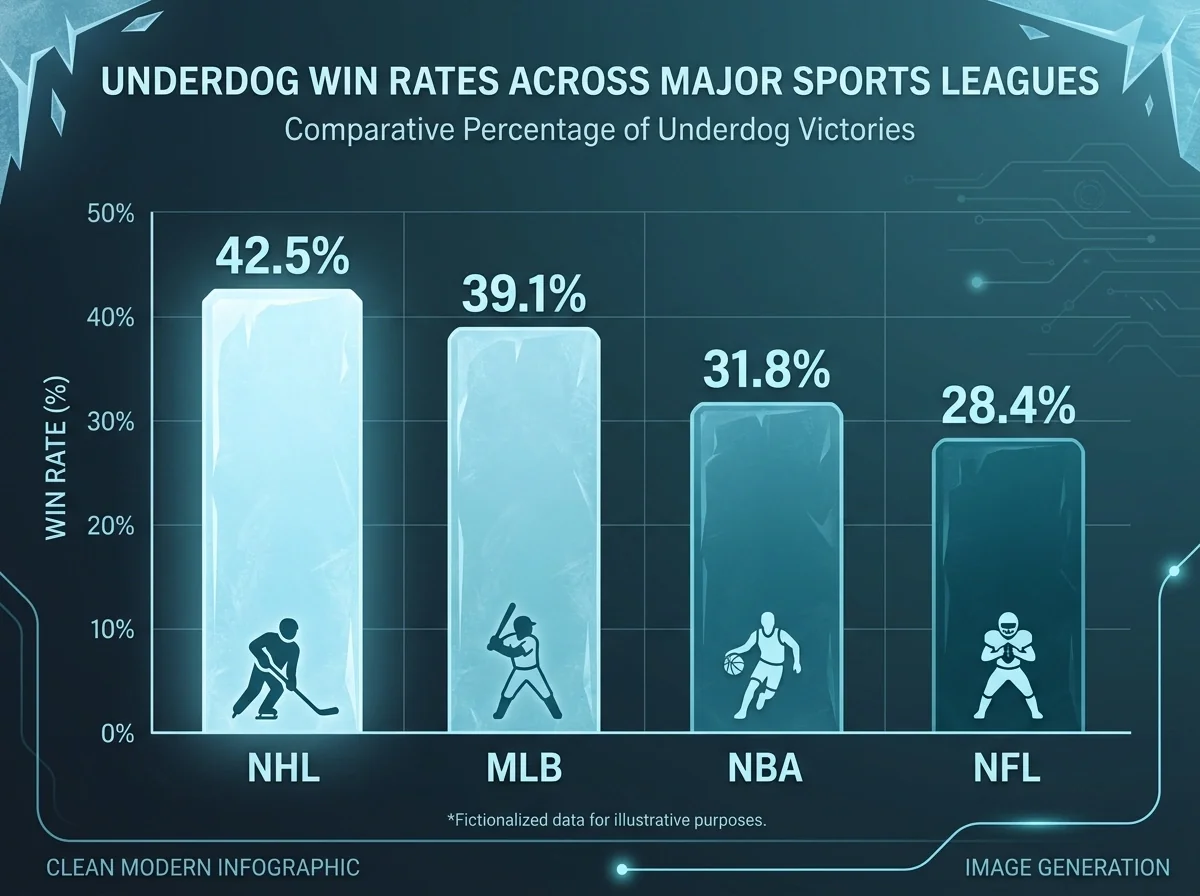
The 2024/25 NHL season delivered a 39.1% underdog win rate. Nearly four out of every ten games went against the expected outcome. That is the second-highest upset frequency among major North American sports, trailing only baseball. The Premier League, by comparison, sees underdogs win roughly a quarter of the time. The gap is not marginal — it is structural, and it reshapes every assumption you carry from football betting into hockey.
Underdog Win Rates Across Major Sports
Context makes the 39.1% figure even more striking. MLB sits just above at around 42%, driven by the single-game variance of starting pitching. The NBA hovers around 32-34%, because talent concentration among superstar-led teams suppresses upsets. The NFL lands near 35%, with its single-elimination format and small sample sizes amplifying randomness. The NHL sits comfortably in the upper tier, and the reason is baked into the sport’s mechanics.
Hockey is low-scoring, goaltender-dependent, and played under a rigid salary cap. A single hot performance from a backup goaltender can neutralise a massive talent advantage. The puck bounces unpredictably off boards and bodies, creating randomness that no amount of skill can fully control. And the 95.5-million-USD salary cap in 2025/26 prevents any franchise from hoarding all the top talent, ensuring that even the weakest roster on paper carries enough quality to compete on a given night.

For bettors, a 39.1% win rate does not automatically mean underdogs are profitable. Profitability depends on the price. If the market prices underdogs at an implied probability of 39% or higher, there is no edge — you are paying fair value. The edge appears when the market underestimates the underdog’s chances, pricing them at 35% implied (odds of 2.85) when they actually win 39% of the time. That four-percentage-point gap is where long-term profit accumulates.
Home Underdogs: the ATS Sweet Spot
The BettorEdge research team highlighted a pattern that I have been exploiting since I first encountered it: Canadian teams often see inflated lines due to hometown bias, which creates value for those betting against them. That observation extends beyond Canada to home underdogs generally, and the puck line data is particularly revealing.

Home underdogs — teams playing on their own ice but priced as less likely to win — won 44.4% of their matches outright in 2024/25. That is close to a coin flip, yet the moneyline routinely priced them at 2.40 or longer. On the puck line, the numbers are even more dramatic: home underdogs covered +1.5 in 63.9% of cases. Favourites visiting the road covered -1.5 only 41.8% of the time. The spread market is telling you that road favourites rarely blow out their opponents, and home underdogs keep games close.

Why does home ice matter so much for underdogs? Three factors. First, the home team gets last change, allowing the coach to deploy favourable matchups against the opponent’s top line. Second, crowd energy matters more for underdogs because it sustains effort through periods where a road team might pack it in. Third, there is no travel fatigue — the visiting favourite may be on the second night of a back-to-back or crossing time zones, while the home underdog slept in their own bed.
The practical application: when I see a home underdog priced at 2.50 or longer on the moneyline, I run through a quick checklist. Is their starting goaltender confirmed? Is the visiting favourite on a back-to-back or a long road trip? Does the home team have a reasonable power play that can steal a goal? If all three boxes tick, I have a bet. If one box fails — particularly the goaltender question — I pass. Selectivity is what turns a 44.4% win rate into actual profit against the margin.
When the Underdog Line Is a Trap
Not every underdog price is a gift. Bookmakers are not stupid, and certain situations produce underdog lines that look generous but reflect a genuine probability gap. Recognising these traps is as important as identifying value spots.

The most common trap is the undermotivated underdog. Late in the season, teams mathematically eliminated from playoff contention sometimes dress a weakened lineup, resting veterans for next season. The moneyline drifts out to 3.50 or 4.00, and the number looks tempting. But the underlying team is not the same squad that compiled a competitive record earlier in the year — key players are absent, energy is low, and the price accurately reflects a team going through the motions.
Another trap is the goaltender mismatch. An underdog price of 2.60 looks attractive until you realise the team is starting a third-string goaltender with a .880 save percentage against an elite offence. The bookmaker already baked that mismatch into the line, and the “value” you think you see is actually fair pricing for a team handicapped in the most important position on the ice.
Divisional familiarity creates a subtler trap. Teams within the same division play each other four times per season, and by the third or fourth meeting, the better team has typically figured out the underdog’s tendencies. The underdog line might not have shortened enough to reflect that learning curve, but the real probability has shifted. Divisional matchups late in the season are where underdogs underperform their season-long averages most consistently.
The discipline of filtering — knowing when to back the underdog and when to walk away — separates a home-away betting strategy that grinds profit from one that leaks it back through indiscriminate wagering. A 39.1% win rate is powerful, but only when wielded with precision.
How often do NHL underdogs win outright?
In the 2024/25 season, NHL underdogs won 39.1% of games — nearly four out of every ten matches. This is the second-highest upset rate among major North American sports, behind only MLB. The rate fluctuates slightly season to season but has consistently remained above 37% for the past decade, reflecting the NHL’s structural parity driven by the salary cap and goaltender variance.
Are road underdogs profitable in NHL betting?
Road underdogs are less profitable than home underdogs because they lack the advantages of last change, crowd support, and no travel fatigue. Home underdogs won 44.4% of matches outright in 2024/25 and covered the puck line 63.9% of the time. Road underdogs win less frequently and face compounding disadvantages from travel and back-to-back scheduling. Selectivity is essential — road underdog bets work best when the favourite is fatigued or starting a backup goaltender.
Prepared by the NHL Hockey Bets editorial staff.