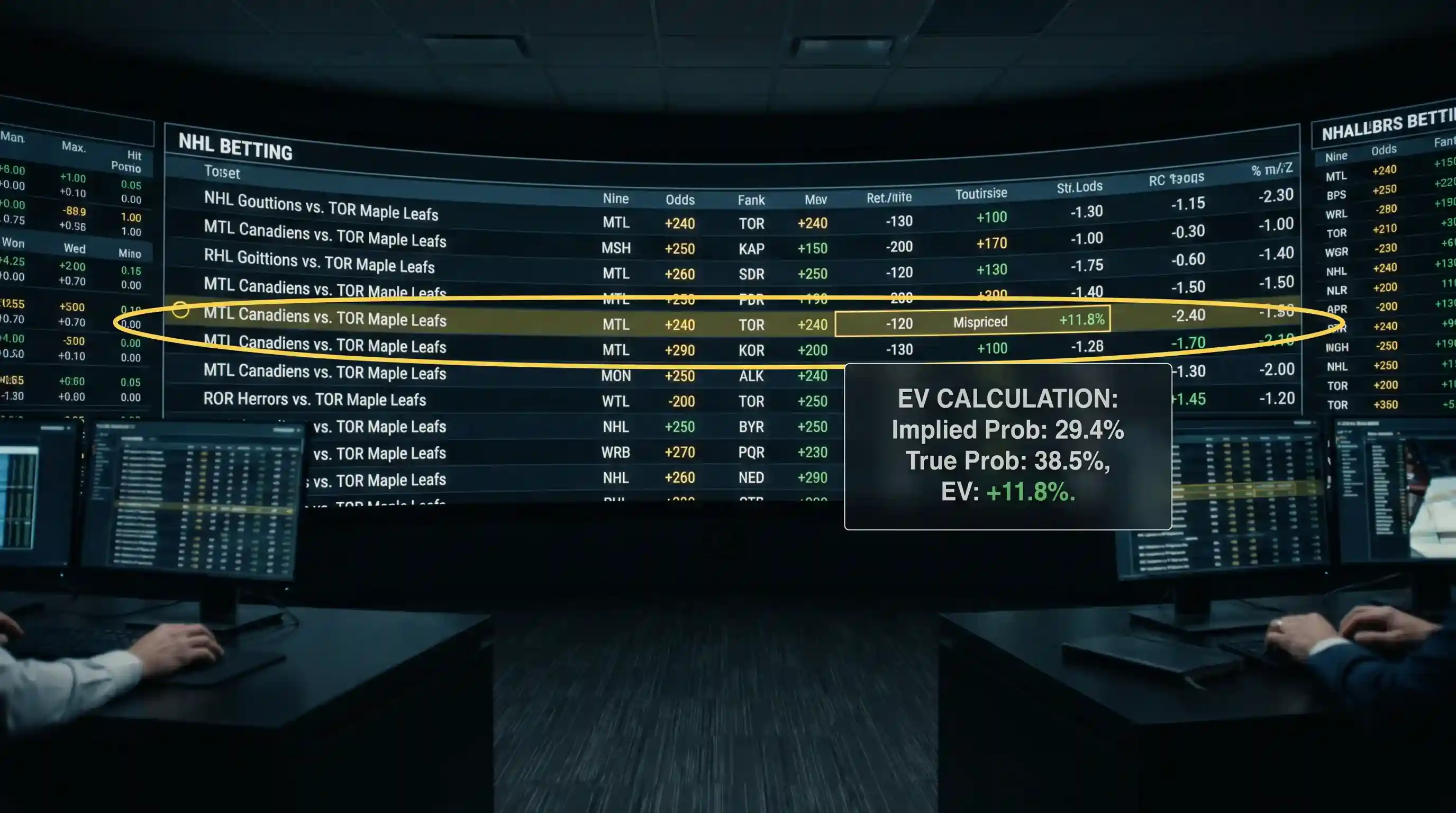
NHL Season Win Totals: Pre-Season Lines and In-Season Value
 Available in US

A Different Flavour of NHL Futures
Most people hear “NHL futures” and immediately think Stanley Cup winner. That market gets the headlines, but it is not where I find the most consistent value. Season win totals — the over/under on a team’s regular-season point total — are quieter, less glamorous, and far more forgiving. You do not need to pick a champion. You just need to decide whether a team will be better or worse than the bookmaker expects over 82 games, and that is a question the data answers more reliably than the crystal ball.

The structure is simple. A bookmaker posts a points line for each team — say, 96.5 for Colorado — and you bet over or under. If Colorado finishes with 97 or more points, the over wins. If they finish at 96 or below, the under wins. The half-point eliminates pushes, so every bet resolves cleanly. Prices typically hover near even money on both sides, with slight adjustments reflecting the bookmaker’s lean.
A league generating record revenue exceeding 7 billion USD attracts sophisticated pricing, but win totals are set months before the season starts, which means they incorporate less information than any in-season market. That information gap is your opportunity.
How Bookmakers Set Season Win Totals
I once asked a bookmaker’s trader how they set opening win totals, and the answer was refreshingly honest: “Last year’s standings, adjusted for offseason moves, and then we wait for the public to tell us what we got wrong.” That two-step process — statistical baseline plus market correction — defines how these numbers come to life.

The baseline starts with the previous season’s point total, adjusted for roster changes, coaching hires, and the salary cap landscape. The cap ceiling for 2025/26 sits at 95.5 million USD, with projections of 104 million for 2026/27. Teams approaching the ceiling have less room to add talent mid-season; teams with cap space can improve through trades and free-agent signings. The bookmaker prices in expected roster construction, not just the roster as it stands on opening night.
Once the number is posted, the market takes over. Sharp bettors — those with sophisticated models and track records of beating the closing line — place early wagers that push the line toward efficiency. Public money follows later, often inflating the totals of popular teams. The interplay between sharp and public money shapes the final number, and understanding where each side has moved the line tells you which direction the remaining value lies.
Divisional context matters too. A team projected at 95 points in the Atlantic Division faces a different competitive environment than a 95-point team in the Central. Strength of schedule is baked into the projection models but not always accurately, especially when the models underestimate the impact of a single division rival’s improvement or collapse.
Spotting In-Season Value as the Standings Shift
Pre-season is not the only window for win total bets. Many bookmakers keep the market open through the first half of the season, adjusting the line as results accumulate. This is where the most exploitable gaps appear, because the market overreacts to hot and cold starts.

NHL underdogs won 39.1% of games in 2024/25, which means even strong teams lose frequently. A team projected at 100 points that starts the season 8-12-2 will see its win total line drop sharply — perhaps from 100.5 to 90.5. But if the underlying process remains strong — positive expected-goals differential, high shot quality, strong goaltending metrics despite the record — the line has overcorrected, and the over becomes a value play.
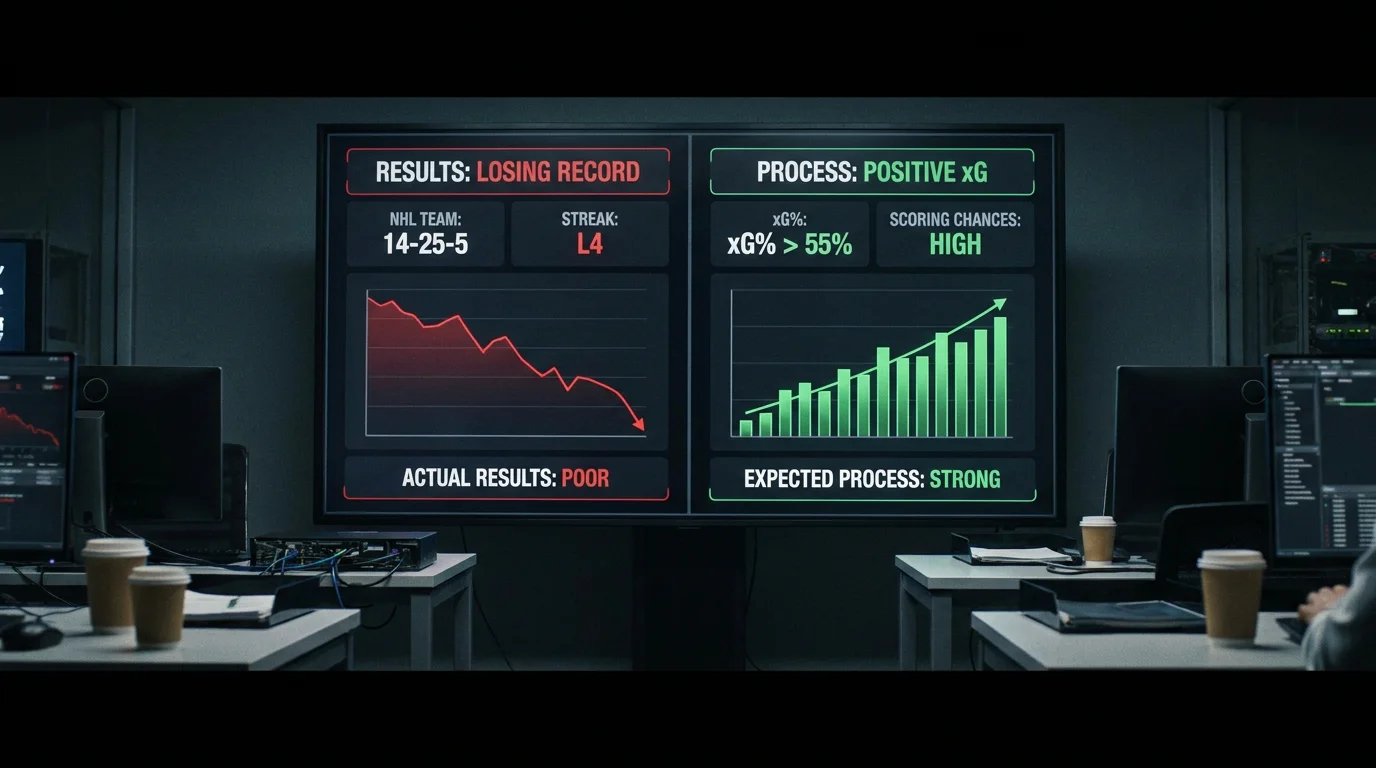
The reverse is equally true. A mediocre team that starts 14-6-1 on a run of fortunate bounces and unsustainable shooting percentages will see its total climb. If the underlying data does not support the record, the under at the inflated number carries genuine edge.
My approach is to set a pre-season target for each team — my own projected point total, derived from roster analysis, cap situation, and divisional strength — and then compare that target to the live line throughout the season. When the gap between my number and the market number exceeds five points, I act. When it is narrower, I wait. Patience is the hardest part of win total betting, because the resolution is months away and the temptation to tinker is constant.
When to Hold, Hedge or Let It Ride
By February, most win total bets have a clear trajectory. Your selection is either tracking toward the over, trending toward the under, or sitting uncomfortably close to the line. Each scenario demands a different response.

If your team is well ahead of pace — say, you took Over 95.5 and they are on a 105-point pace at the midpoint — you have a decision. You can hold and let the bet resolve naturally, accepting the risk that injuries or a late-season slide could pull the total back toward the line. Or you can hedge by taking the under at the new, higher line — locking in a smaller guaranteed profit regardless of how the season finishes. The hedge math is identical to any futures hedge: calculate the expected value of your current position, then size the opposing bet to guarantee a minimum return.
Dead positions are harder. If you took Over 98.5 and the team is on an 85-point pace at the midpoint, the bet is almost certainly lost. Cash-out offers from bookmakers will be minimal — pennies on the pound. In most cases, the rational play is to let the ticket expire rather than accept a derisory cash-out, because the money is already spent and the residual probability of a miraculous late-season run, while small, is not zero.
The discipline lies in treating each win total bet as a standalone investment with a defined time horizon. Do not let a losing position influence your staking on other markets, and do not chase the loss by doubling down on the same team in nightly games. Season win totals are slow-burn bets, and treating them with the patience they demand is what separates the bettors who profit from futures markets from those who simply occupy them.
Do season win totals include overtime wins?
Yes. NHL standings award two points for any win, whether in regulation, overtime, or a shootout. A team that wins 45 games in regulation and 10 more in overtime or shootouts collects the same 110 points as a team that wins all 55 in regulation. Season win total lines are expressed in points, not wins, so all types of victories contribute equally to the final number.
When is the best time to bet on NHL season win totals?
The widest value windows are immediately after the lines are posted in summer, before sharp money corrects them, and during the first quarter of the season when the market overreacts to small-sample results. By midseason, lines are tighter and reflect more data, reducing the available edge. If you have a strong pre-season model, early entry captures the largest discrepancies between your projection and the market number.
Published by the NHL Hockey Bets team.