
NHL Same-Game Parlay: Building Multi-Leg Bets That Make Sense
 Available in US

The SGP Boom in NHL Betting
Three years ago, building a same-game parlay on an NHL match from a UK bookmaker was either impossible or buried so deep in the interface that nobody bothered. Today it sits front and centre on every major platform, and for good reason — the NHL has partnered with four of the biggest betting operators, including Caesars, BetMGM, DraftKings, and FanDuel, driving product development that trickles down to UK-licensed sportsbooks carrying the same technology.

A same-game parlay, or SGP, combines multiple selections from a single match into one bet. You might take the home team on the moneyline, the over on total goals, and a specific player to score — all from the same game, all on one slip. Each leg multiplies into the next, producing combined odds that can reach 8.00, 15.00, or higher. The appeal is obvious: big potential payouts from a single match. The risk is equally obvious: every leg must win, and one failure collapses the entire bet.
UK bookmakers often brand this feature as a “bet builder” rather than “same-game parlay”, but the mechanic is identical. The terminology comes from the American market, where SGPs have exploded in popularity. Regardless of the label, the underlying pricing and structure follow the same rules — and the same traps.
How Same-Game Parlays Are Priced
Standard accumulators multiply independent odds together. If you back three separate games at 1.80 each, the combined price is 1.80 x 1.80 x 1.80 = 5.83. Same-game parlays cannot use that formula because the legs are not independent — they come from the same match, and outcomes influence each other. If you take the over on total goals, a player scoring becomes more likely simply because more goals are being scored. Bookmakers use correlation models to adjust the combined price downward, accounting for these dependencies.
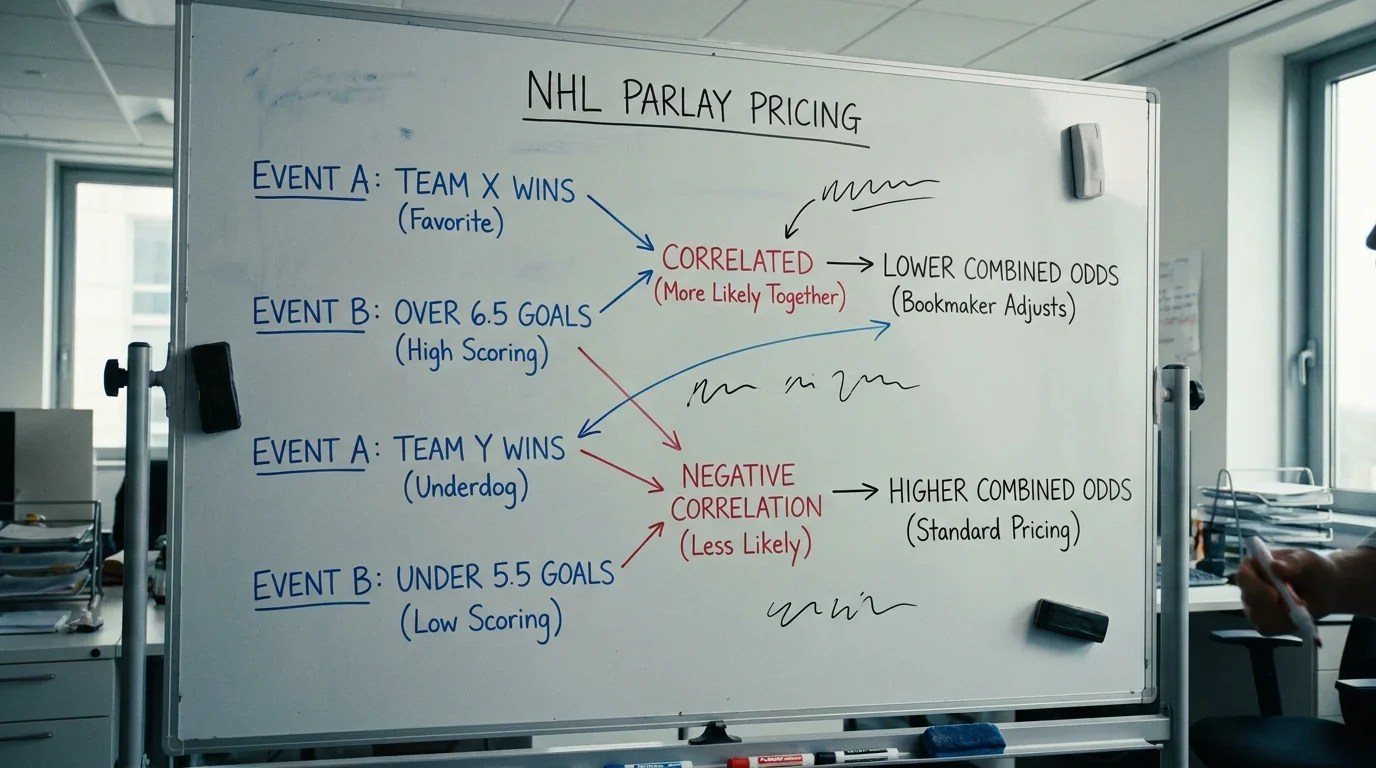
In practice, this means SGP odds are lower than you would get by naively multiplying individual leg prices. The bookmaker’s model says “these events overlap, so the true combined probability is higher than the product suggests, and we will price accordingly”. The exact adjustment is opaque — no operator publishes its correlation matrix — but you can infer it by comparing the SGP price to the naive multiplication. The bigger the gap, the more the bookmaker thinks your legs are correlated.
Margins compound inside an SGP. Each leg carries its own built-in margin, and when you multiply three or four legs together, those margins stack. A three-leg SGP built from markets that each carry a 5% margin does not carry 5% combined margin — it is closer to 15%. That margin erosion is the hidden cost of SGPs and the primary reason they are so profitable for bookmakers.
Constructing a Logical NHL SGP
A good SGP tells a coherent story about how you expect the game to unfold. Every leg should reinforce the same narrative rather than pulling in random directions. Start with a game thesis — say, “this is going to be a high-scoring home win” — and then select legs that align: home team moneyline, over on total goals, a home team forward to score, and perhaps the home team to lead after the first period.

Each leg you add should flow from the thesis. If you believe the game will be high-scoring, do not add a goalie saves under as a fourth leg — that contradicts the high-scoring premise. If you are backing the underdog, do not pair it with their top scorer going under on shots, because underdogs who win typically generate strong offensive volume. Internal consistency is what separates a structured SGP from a lottery ticket.

I limit myself to three legs on most NHL SGPs. Each additional leg reduces the probability of success dramatically, and the odds boost from a fourth or fifth leg rarely compensates for the added risk. Three legs built from a clear thesis — say, team to win at 1.60, over 6.5 goals at 1.85, and a specific player to score at 2.80 — produces a combined price around 8.28 before the bookmaker’s correlation adjustment. After adjustment, you might see 6.50 or 7.00. That is still an attractive return if your thesis holds, and three legs keep the hit rate in a realistic range.
Here is a worked example in GBP. You build a three-leg SGP: home team wins (1.55), over 5.5 goals (1.70), and a named forward scores anytime (2.50). The naive multiplication gives 6.59, but the bet builder prices it at 5.40 after correlation adjustment. A 10 GBP stake returns 54 GBP if all three legs land. The effective margin embedded in that adjustment is the cost you pay for combining correlated events on one slip.
Correlation Traps: Legs That Cancel Each Other
The most common SGP mistake I see is pairing legs that work against each other statistically. NHL betting rewards patience and process more than star-gazing, as one analysis from Tech Insider put it, and nowhere is that truer than in SGP construction.

The classic trap: backing the under on total goals and a player to score over 0.5 goals. These are not contradictory in every case — a game can finish 2-1 and your player can score one of those goals — but they push in opposite directions. The under implies fewer goals, which means fewer opportunities for any individual to score. The bookmaker’s model sees this negative correlation and barely adjusts the combined price, making it look deceptively attractive.
Another frequent error: combining a heavy favourite on the moneyline with the underdog’s top scorer to register over 3.5 shots. If the favourite dominates possession, the underdog generates fewer shots overall, meaning their players’ shot totals compress. You are betting on dominance and underdog volume at the same time — a narrative that rarely plays out in full.
Positive correlations, by contrast, are your friend. Home team wins + over total goals + home team player scores — all three legs benefit from the same game state, which is the home team controlling play and generating offence. The bookmaker adjusts the price downward because these events travel together, but the adjustment is fair compensation for the real statistical overlap. You are paying for coherence rather than fighting against it.
The discipline of building SGPs from a single narrative, rather than chasing the highest possible combined odds, is what separates bettors who grind profit from this market and bettors who treat it as a weekly lottery.
What is a same-game parlay in NHL betting?
A same-game parlay combines multiple selections from one NHL match into a single bet. All legs must win for the bet to pay out. Typical combinations include a moneyline pick, a total goals line, and a player prop. UK bookmakers often call this feature a ‘bet builder’. The combined odds are adjusted by the bookmaker to account for statistical correlations between the legs.
Can I cash out an NHL same-game parlay early?
Most major UK bookmakers offer partial or full cash-out on SGPs during a live game, though availability depends on the operator and the specific legs in your bet. Cash-out values fluctuate as the game progresses — if your first two legs have already won and the third is pending, the cash-out offer will be higher than if one leg is already at risk. Check your bookmaker’s terms, as some restrict cash-out on certain prop legs.
Prepared by the NHL Hockey Bets editorial staff.