
Puck Line Betting Explained: How the NHL Spread Works
 Available in US

The Puck Line in 30 Seconds
I lost my first puck line bet because I thought it worked like a football handicap. The team I backed won 3-2, and I celebrated — until I checked my slip and realised I had taken them at -1.5. One-goal margin. Bet dead. That lesson cost me twenty quid and probably saved me hundreds over the next decade, because it forced me to understand what the puck line actually does.

The puck line is the NHL’s version of a point spread, but it almost always sits at a fixed 1.5 goals. Favourites carry -1.5, meaning they need to win by two or more. Underdogs carry +1.5, meaning they can lose by a single goal and your bet still lands. Unlike football spreads that shift between 1, 1.5, 3, or even 7 points depending on the matchup, the puck line rarely budges from that 1.5 figure. What changes instead is the price attached to each side.
Home underdogs cover the puck line in 63.9% of cases during the 2024/25 season, which tells you that the -1.5 threshold is hard for favourites to clear consistently. Hockey is a low-scoring sport — most games land between five and seven total goals — so a two-goal winning margin is genuinely difficult to manufacture. That single number, 1.5, defines the entire market and creates opportunities that the moneyline alone cannot offer.
How +1.5 and -1.5 Shape Your Bet
Think of it as an insurance policy on one side and a courage test on the other. When you take a team at +1.5, you are buying yourself a one-goal cushion. Your selection can lose 3-2, 4-3, even 6-5, and you still collect. The only way you lose is if the opposition wins by two or more goals. That safety net comes at a cost: the odds on +1.5 favourites are typically short, sometimes as low as 1.25 in decimal terms.

Flip to -1.5 and the dynamic reverses entirely. You are betting that the favourite does not just win but dominates. A 2-1 victory is not enough. You need 4-2, 5-3, 6-1 — any scoreline where the gap is at least two goals. Because this is harder to achieve, the bookmaker compensates you with longer odds. A favourite priced at 1.45 on the moneyline might sit at 2.30 or higher on the puck line.

Here is a worked example in pounds. Suppose Toronto is -1.5 at odds of 2.40, and you stake 10 GBP. If Toronto wins 5-2, your return is 24 GBP — a 14 GBP profit. If Toronto wins 3-2, your bet loses despite the team winning the match. That gap between team winning and bet winning is where the puck line lives, and it catches newcomers constantly.
The opposite side in that same match might be the opponent at +1.5 priced at 1.55. A 10 GBP stake returns 15.50 GBP if they lose by one goal or win outright. Lower profit ceiling, but far higher hit rate. The question is always which side offers better value relative to the probability of the outcome — and that requires looking at the data, not just the scoreboard.
Puck Line Records: Favourites vs Underdogs
Numbers do not lie, and the puck line numbers tell a story that surprises most people who come to hockey from football betting. During the 2024/25 season, home favourites covered the -1.5 puck line just 41.8% of the time. Read that again: the team expected to win, playing on home ice, failed to cover more often than it succeeded. Meanwhile, home underdogs covered +1.5 at that 63.9% clip I mentioned earlier.
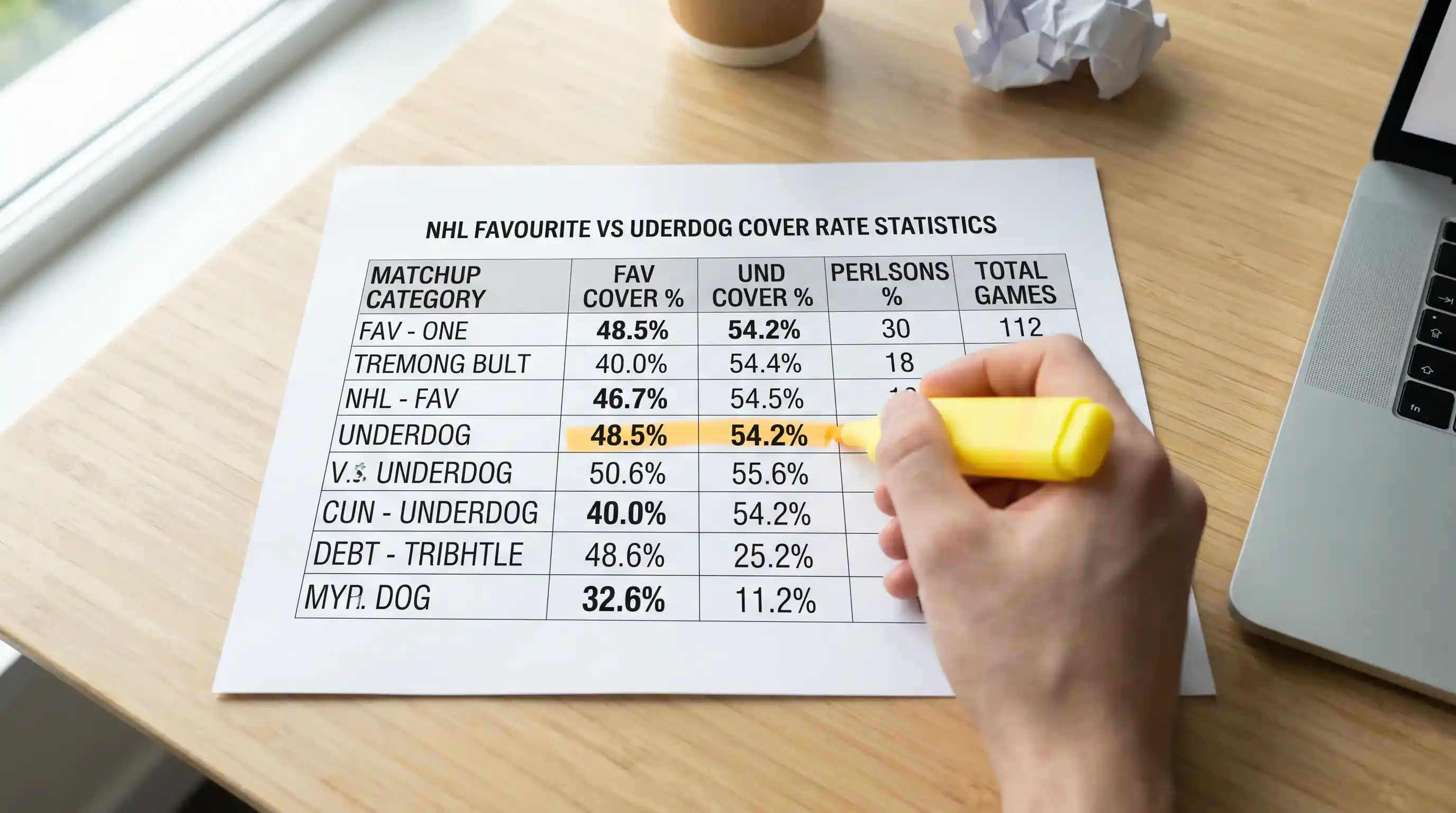
Why such a lopsided split? Hockey’s competitive balance is tighter than almost any other major sport. NHL underdogs won 39.1% of games outright in 2024/25 — the second-highest upset rate among North American leagues, trailing only baseball. When underdogs win that frequently on the moneyline, they cover the puck line even more often because every outright win is an automatic +1.5 cover, and every one-goal loss adds to the total.
This does not mean you should blindly bet every home underdog on the puck line. Odds reflect probability, and bookmakers adjust the price to account for the higher cover rate. A +1.5 line at 1.30 is pricing in roughly a 77% implied probability, which means the 63.9% actual cover rate still would not produce long-term profit at that price. The edge appears when the price drifts above the break-even point for the real cover percentage — and that requires comparing lines across underdog betting trends and multiple bookmakers.
When the Puck Line Beats the Moneyline
Last season I tracked every NHL match where the moneyline favourite was priced below 1.35 — heavy favourites expected to cruise. In those spots, the moneyline return was so thin that you needed an unrealistically high win rate just to break even after margin. The puck line on those same favourites, however, often sat between 1.90 and 2.20. Suddenly, a favourite you already believed would win comfortably was offering near-double returns.

The puck line is most powerful in blowout-profile games. When a top-five team hosts a bottom-five team, the moneyline might price the favourite at 1.22 — staking 10 GBP to win 2.20 GBP profit. Taking that same team at -1.5 and 2.05 turns the same 10 GBP stake into a 10.50 GBP profit. You are accepting a harder condition, but in matchups with a large talent gap, the two-goal margin is more likely than the compressed moneyline odds suggest.
The reverse scenario matters too. When two evenly matched teams meet and you fancy the underdog, the moneyline might pay 2.80 — attractive, but the team still has to win. Taking +1.5 at 1.50 gives you a safer path: the underdog can lose by one and you still profit. In a league where roughly 30% of games head to overtime in recent seasons, single-goal margins are extremely common, and the +1.5 cushion captures all of them.
The puck line is not better or worse than the moneyline — it is a different tool for different situations. Heavy-favourite nights favour -1.5. Tight, competitive matchups favour +1.5. The skill lies in reading the matchup and choosing the right instrument, not defaulting to one market every night.
Does the puck line include overtime and shootouts?
Yes. Standard puck line bets include overtime and shootout results. If your team is +1.5 and loses in a shootout, the final score counts as a one-goal loss, so your bet wins. If you have -1.5 and the game reaches overtime at all, it means regulation ended within one goal — so a shootout or OT winner only adds one goal to the margin, and -1.5 typically still loses unless the OT score creates a two-goal gap in the final tally.
What happens to a puck line bet if the game ends 3-2?
It depends which side you hold. If you backed the winning team at -1.5, your bet loses because the margin is only one goal. If you backed the losing team at +1.5, your bet wins because they lost by fewer than 1.5 goals. The scoreline 3-2 is the single most common outcome that splits puck line bettors — favourites lose the spread while underdogs cover it.
Prepared by the NHL Hockey Bets editorial staff.